
Biscuit packaging is changing in a more structural way than many brands expected.
For years, premium biscuit tins were often treated as seasonal packaging—something reserved for Christmas collections, anniversary editions, or special gift sets. Everyday biscuit lines, by contrast, moved toward lighter cartons, pouches, and hybrid paper-based formats in the name of cost efficiency and convenience.
That logic is no longer as stable as it once was.
In 2026, biscuit packaging is being reassessed through a different lens. Brands are no longer asking only whether a pack is visually attractive or easy to distribute. They are increasingly asking whether it can justify its material footprint, stay useful after purchase, hold up better in logistics, and support long-term brand value rather than one-time disposal.
This shift is one reason metal biscuit tins are returning to serious commercial discussion. Not because they are new, but because their strengths—durability, reusability, shelf presence, and premium positioning—now fit several market pressures at the same time.
The point is not that every biscuit product should move into metal. That would be unrealistic. The real trend is that tins are being reconsidered as part of a smarter packaging mix, especially for premium retail, gifting, collector-style products, and lines where long-term brand presence matters as much as first-sale visibility.
One of the clearest changes in biscuit packaging is that sustainability is no longer judged only by what the pack is made from. It is increasingly judged by what happens to the pack after purchase.
For a long time, packaging claims focused on simple material language:
Those claims still matter, but they are no longer enough on their own. More buyers and brand teams are asking a harder question:
Does the packaging actually stay in use, or does it become waste immediately?
That question works in favor of biscuit tins.
A biscuit tin rarely functions as a one-time-use container. It is often reused for:
That second life changes how consumers interpret the pack. It also changes how brands evaluate packaging value. A tin that stays visible in a kitchen or cupboard for months delivers a different kind of brand exposure than a carton thrown away the same day.
This is why sustainability in biscuit packaging is increasingly shifting from “Can this be recycled?” to “Does this remain useful long enough to justify the material?”
That does not mean recyclability is irrelevant. It means circularity is now being judged through both recycling potential and continued use.
For metal biscuit packaging, the strongest sustainability case usually comes from combining two facts:
This dual value is important.
A biscuit tin does not need to be thrown away immediately after consumption. If and when it is eventually discarded, the recovery path is also relatively clear. In practical terms, tins are easier for consumers to understand than many composite formats. People generally know they can rinse them, place them into the metal recycling stream, and let municipal or industrial sorting systems separate them using magnetic recovery.
From there, the material can be crushed, melted, cleaned, and processed into new steel-based products again.
That clarity matters. In packaging, consumer understanding is often underestimated. A technically recyclable pack is less convincing if people do not know how to sort it. Biscuit tins have an advantage because their material identity is obvious.
Another important point is that circularity is not only about the end of life. It is also about delaying that end point. A tin that is used repeatedly for storage performs differently from a format designed for immediate disposal. In that sense, metal biscuit tins often align better with real-world circular behavior than packaging that is theoretically recyclable but practically short-lived.
Durability used to be discussed mainly as a logistics issue. Now it is increasingly part of sustainability logic as well.
That shift is important.
If a biscuit package is too weak to survive transport efficiently, or if it crushes easily in premium retail distribution, the cost is not only aesthetic. It can also increase:
This is one reason metal biscuit tins are being reassessed. Their rigidity changes more than shelf appearance. It can also improve:
For premium biscuits, shortbread, butter cookies, and gift assortments, that structural reliability matters.
This is also where tins differ from some rigid paper-based formats. A carton may look premium on shelf, but under transport pressure, moisture variation, or repeated handling, the performance difference becomes obvious. A biscuit tin tends to hold its form better and continue looking premium longer.
That durability is increasingly being treated as part of the sustainability conversation because a more stable package often reduces downstream waste.
Another major change in biscuit packaging is how “premium” is being expressed.
For a long time, luxury packaging often leaned on visual abundance:
That approach still exists, but it is no longer the only premium language. In 2026, many biscuit brands are moving toward a more restrained version of luxury.
In this new logic, premium value is often communicated through:
This is one reason metal tins are regaining strength in the premium segment. They do not need to look loud to feel valuable. A simple embossed logo, a matte finish, a clean color palette, and a well-proportioned lid can now signal premium quality more effectively than over-decoration.
This also explains why sustainable packaging does not have to look plain or compromised. Many brands are no longer treating sustainability and premium branding as opposing goals. Instead, they are using metal tins to express both at once: a packaging format that feels elevated, but also justifiable.
In practice, this means premium biscuit tins in 2026 are less about “look how decorative this is” and more about “this is a pack worth keeping.”
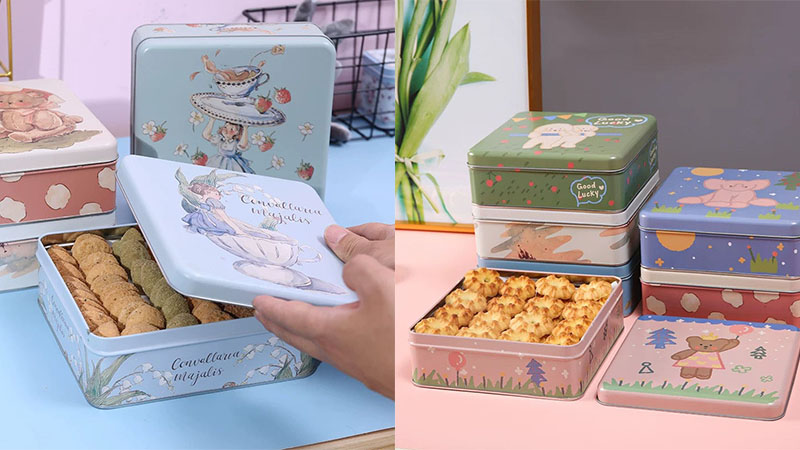
Not every biscuit brand needs a tin. But when brands compare packaging options more carefully, metal often becomes more competitive than it first appears.
| Packaging Format | Protection | Reuse Potential | Premium Shelf Presence | Sustainability Perception | Typical Best Use |
| Metal biscuit tin | High | High | High | Strong | Premium biscuits, gifting, reusable packaging |
| Folding carton | Medium | Low | Medium | Medium | Mass retail, lower-cost premium ranges |
| Flexible pouch | Low to medium | Low | Low to medium | Weak to medium | Value lines, convenience-led distribution |
| Plastic tray + outer wrap | Medium | Low | Medium | Weak | Fragile products needing shape control but lower perceived value |
The point of this comparison is not to say that tins should replace everything. It is to show why more brands are revisiting them.
Tins are rarely the cheapest unit-cost option. But once the discussion includes:
their role starts to make more commercial sense.
A useful point that often gets missed in global packaging discussions is that biscuit tin demand is not rising for the same reason in every region.
Some markets are driven more by compliance and material clarity. Others are driven more by gifting culture or display traditions.
| Region | Main Driver for Biscuit Tins |
| Europe | Compliance visibility, recyclability, premium sustainability claims |
| UK & Middle East | Gifting culture, seasonal presentation, long-standing tin affinity |
| North America | Selective premiumization, flagship SKUs, stronger differentiation for fewer lines |
This matters for strategy.
A biscuit tin range developed for a European market may need stronger language around:
A range developed for the UK or Middle East may benefit more from:
Meanwhile, North American demand is often more selective. Not every SKU is likely to move into metal, but premium sub-lines and special retail editions may.
So the question is not simply “Are biscuit tins growing globally?” It is more useful to ask:
In this target market, what problem is the tin actually solving?
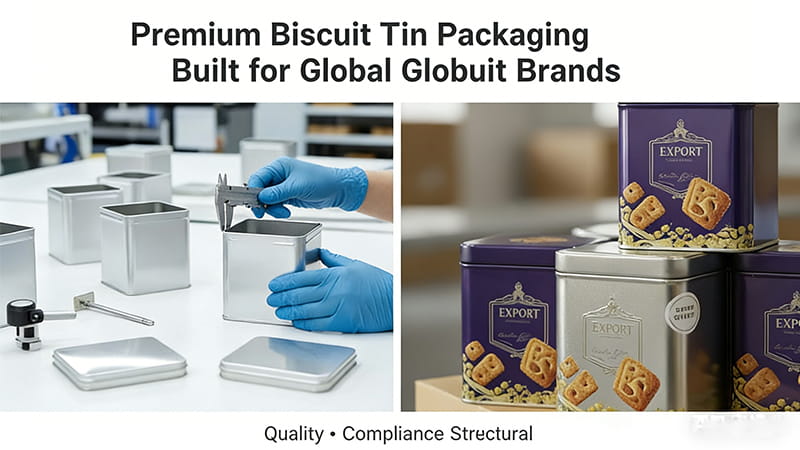
This is one of the most important shifts for packaging buyers.
A few years ago, sustainability in biscuit packaging was often handled as a branding layer. Today it is increasingly appearing in technical conversations.
Buyers are more likely to ask questions such as:
That change matters because it moves sustainability out of vague messaging and into procurement criteria.
For biscuit tins, this creates both an opportunity and a higher standard. Brands cannot rely only on saying “metal is recyclable.” They also need suppliers who can discuss:
In other words, sustainability now has to survive technical questioning, not just visual storytelling.
Another useful perspective is that sustainable biscuit packaging is not only about brand messaging or consumer behavior. It is also about what changes inside the factory.
Leading biscuit tin manufacturers are increasingly exploring or implementing:
This is important because it reminds buyers that “sustainable packaging” does not start only at the final pack design. It also begins with how the tin is produced.
At the same time, this transition is not effortless. Greener coating systems can be harder to stabilize. Alternative materials may introduce new technical limits. Cleaner processes may also increase cost or require new process control.
That is why sustainable manufacturing is best treated as an operational capability, not a marketing shortcut.
For buyers, the practical takeaway is simple: if sustainability is a serious part of the packaging brief, supplier evaluation should include manufacturing practice, not only finished-pack appearance.
The return of biscuit tins is not happening because brands want to go backward. It is happening because tins now answer several current demands at once:
What has changed is not the tin itself. What has changed is the commercial logic around it.
In 2026, biscuit tins make sense when brands need packaging that can carry both material credibility and brand value at the same time.
For brands considering biscuit tins, the most useful supplier conversations usually begin with practical questions:
Those questions lead to better packaging decisions than jumping straight into decoration.
A biscuit tin is no longer just a nostalgic packaging format. In the right product category, it can be a highly modern answer to durability, circularity, gifting, and premium positioning—all at the same time.
Obtenha as últimas informações e ofertas especiais


 Rede IPv6 suportada
 Português
 English
 Français
 Deutsch
 Español