
Around late 2024, something interesting happened. Buyers who had worked with tin packaging for years suddenly began sending unusually detailed questions—“What tinplate grade are you using?”, “Is this coating epoxy-free?”, “How do you keep Pantone colors stable across 60,000 units?”
These weren’t the typical price-driven inquiries. They came from brands that had dealt with a failed shipment, an unstable ink layer, a cookie tin that rusted during sea freight, or a compliance issue at customs. And they reflected a shift: cookie tin packaging was no longer seen as a simple metal box. For many buyers, it had become a risk point that must be controlled precisely.
Anyone who has walked a tin box factory knows that quality never comes from “inspection at the end.” A good OEM cookie tin factory builds quality backward—from raw materials to tooling, printing curves, drying temperature, and even palletizing patterns.
In this industry, three things decide whether the final cookie tin looks premium or problematic:
When a factory can hold these three lines steadily, the rest naturally lands in place.
A bump on the tinplate, a hairline scratch on the coating, or a slight misalignment between body and lid seems minor on a single sample. But when multiplied across 20,000–80,000 units, these “small defects” become shipment-level risks.
Most buyers only see finished tins. On-site, we see how storage humidity, cutting burrs, or uneven varnish thickness quietly influence long-term quality.
SPTE tinplate from different mills—Guangdong, Baosteel, Japan, or Korea—carry subtle differences in flatness, coating weight, and hardness. A cheaper substrate may look fine at first but causes wrinkling during curling or weak lid sealing.
This is why experienced OEM factories control materials from the first minute—not the last.
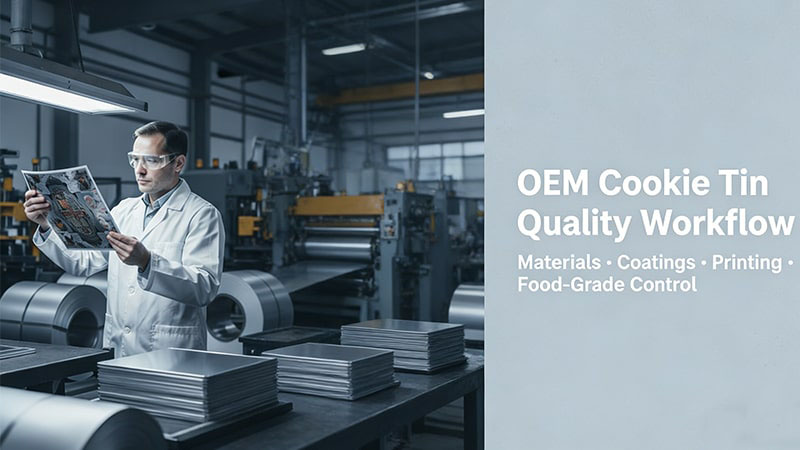
Every factory can produce a flawless sample. The question is whether the same finish can be repeated 50,000 times. The biggest gap appears in mass printing—color drift between batches or gloss deviation under different drying speeds.
Peak seasons—especially before Christmas cookie tin production—often compress timelines. This is when QC shortcuts happen: incomplete curing, insufficient cooling time, rushed packaging when varnish is still soft. A vendor that insists on refusing shortcuts is usually the one that protects your brand best.
A simple comparison shows how metal selection affects real-world performance:
Material Variations & Outcomes in Cookie Tin Production
|
Tinplate Grade / Source |
Typical Thickness Used |
Common Issues |
Best Use Case |
|
Low-grade SPTE (Local) |
0.21–0.23 mm |
Easy denting, color instability after baking |
Low-cost promotional tins |
|
Mid-grade SPTE (Baosteel) |
0.23–0.25 mm |
Stable forming, fewer wrinkles |
Mid-market cookie tins |
|
Premium Tinplate (Japan/Korea) |
0.23–0.28 mm |
Excellent flatness, consistent color |
High-end gift tins & export brands |
This is why professional OEM factories do not treat tinplate as a commodity—it decides the entire forming performance.
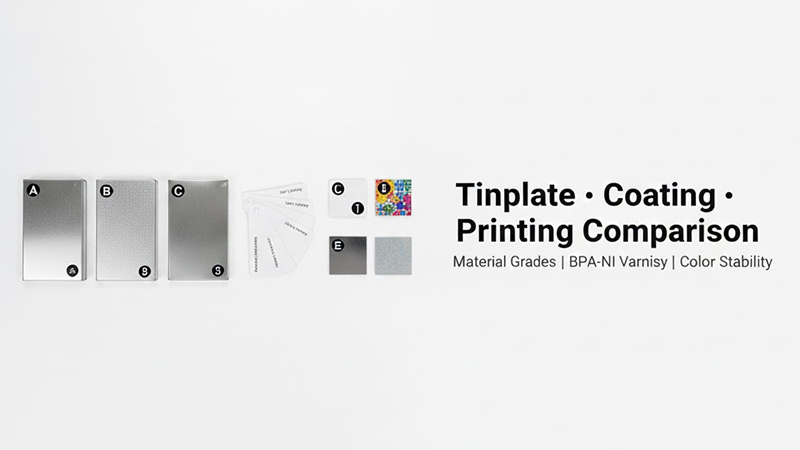
Here is a simplified comparison of common coating systems:
Coating Systems Used in Cookie Tin Manufacturing
|
Coating Type |
Properties |
Food-Grade Safety |
Typical Risk |
|
Standard Epoxy |
Good adhesion, low cost |
Requires batch testing |
Potential migration issues |
|
BPA-NI Varnish |
Lower odor, stable color |
Safer for food contact |
Higher material cost |
|
UV Coating |
High gloss, scratch-resistant |
Requires specialized curing |
Color shift if curing uneven |
Most buyers only compare printing precision. In reality, coatings are what determine health compliance and long-term durability.
Risk peaks in three stages:
Even with the same Pantone code, humidity, ink viscosity, and drying cycles affect the final color. This is why an experienced tin box factory calibrates every batch—not only the first one.
We often see buyers surprised by how much manual work still exists: manual edge polishing, hand inspection for dust before printing, and workers checking varnish reflection under strong light. They finally understand why two factories with the same quote can deliver very different results.
Tooling pressure, stamping speed, curing temperature—all require constant calibration. Good manufacturers tweak these parameters daily, not only during the first run.
A premium cookie tin is not defined by one perfect sample. It’s defined by how well a factory can repeat that quality across thousands of units, under time pressure, with stable materials, consistent coatings, and predictable tooling behavior.
Repeatability—not creativity—is what protects brands.
Looking ahead, the factories that will stand out are those investing in:
Quality control in cookie tin manufacturing will move from “manual experience” to “data-driven predictability.”
The factories preparing for that shift will become the long-term partners buyers rely on.

Obtenha as últimas informações e ofertas especiais


 Rede IPv6 suportada
 Português
 English
 Français
 Deutsch
 Español