
When developing round tin packaging, many brands first focus on the outside of the tin: the shape, printing, color, logo position, surface finish, and lid style. These details are important because they decide the first impression.
But in real packaging projects, the inside structure often decides whether the package works well or not.
For candies, cookies, chocolates, cosmetics, candles, tea gifts, and promotional products, the inner tray or insert can affect product protection, opening experience, packing efficiency, and total packaging cost. A good tray keeps the product in place and makes the tin look more finished. A poor tray may cause shaking, broken products, difficult lid closing, or extra assembly time.
This guide explains how to judge the right fit and wrong fit for round tin inserts, how different tray materials affect cost, when a custom mold is needed, and when you may not need an inner tray at all.
Before going into materials and cost, here is a simple way to check the problem.
| Problem You See | Possible Reason | What to Check |
| Product moves inside the tin | Tray is too loose or no positioning structure | Cavity size, tray diameter, product weight |
| Lid does not close smoothly | Tray or product is too high | Tin inner height, lid depth, top clearance |
| Product is hard to take out | Tray cavity is too tight | Product tolerance, cavity depth, removal space |
| Tray edge bends during packing | Tray material is too thin or too tight | Material thickness, tray outer diameter |
| Product looks messy after shipping | Tray does not hold the product firmly | Shaking test, carton packing method |
| Packaging cost is too high | Material or mold choice may be over-designed | Compare paperboard, plastic, foam, and no-tray options |
This quick check is useful at the sample stage. Many round tin packaging problems are not caused by the tin itself, but by the insert being slightly too loose, too tight, too high, or not suitable for the product.
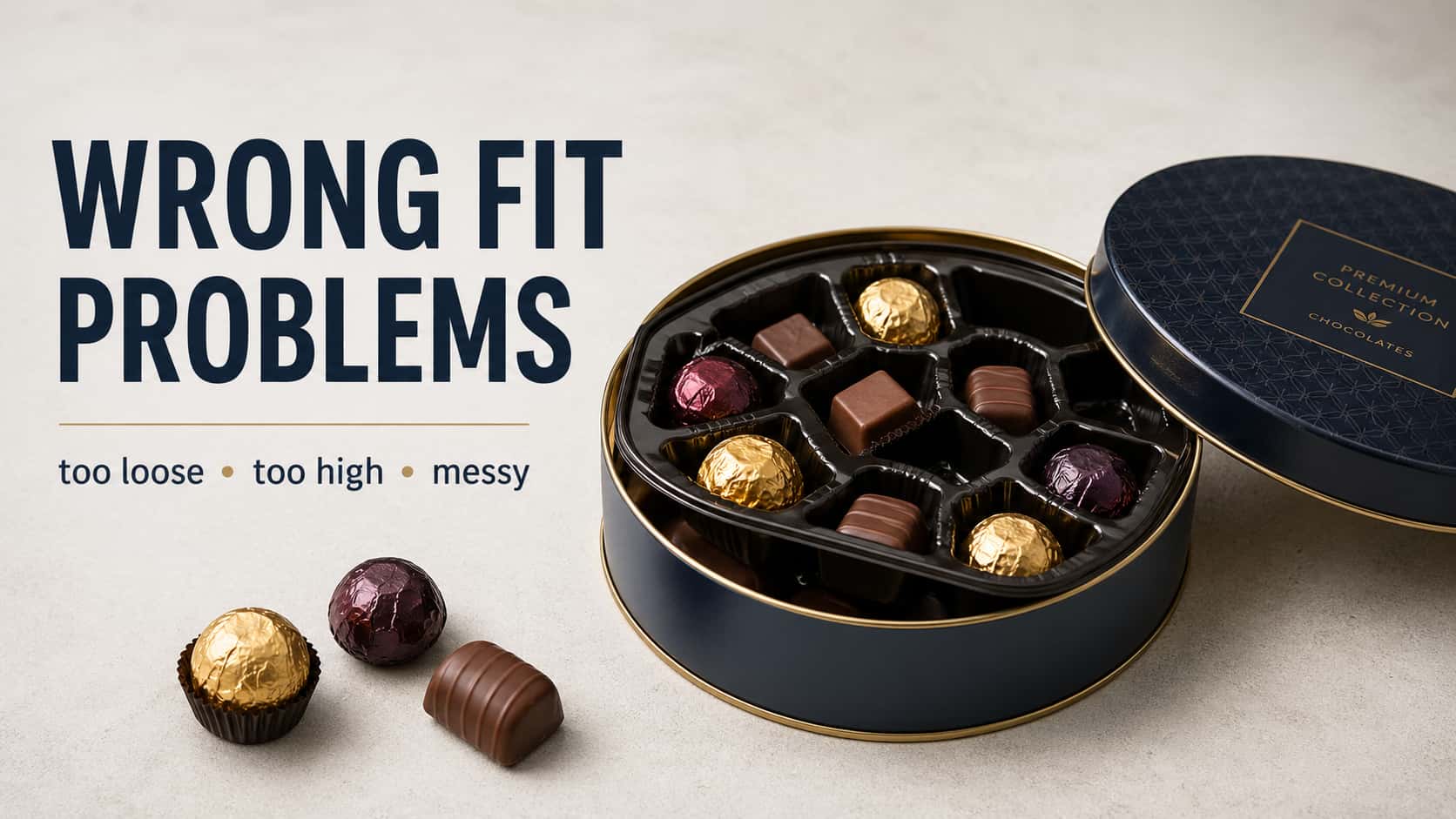
A round tin is more than a metal container. In many retail and gift packaging projects, it is part of the product value.
When the customer opens the lid, the product should look clean, stable, and well arranged. If the items have moved around inside the tin, the package will feel less professional, even if the outside printing is beautiful.
A well-designed inner tray helps in four ways.
First, it protects the product during transportation. This is especially important for cookies, chocolates, cosmetics, candles, and fragile gift items.
Second, it improves the opening experience. A neat layout makes the product look more premium.
Third, it makes packing easier. If the tray fits well, workers can place the product quickly and consistently.
Fourth, it reduces hidden costs. Poor fitting may lead to slower assembly, more rejected samples, extra repacking work, or customer complaints after delivery.
For custom tin packaging, the insert should be considered together with the tin size, product size, lid clearance, packing method, and budget.
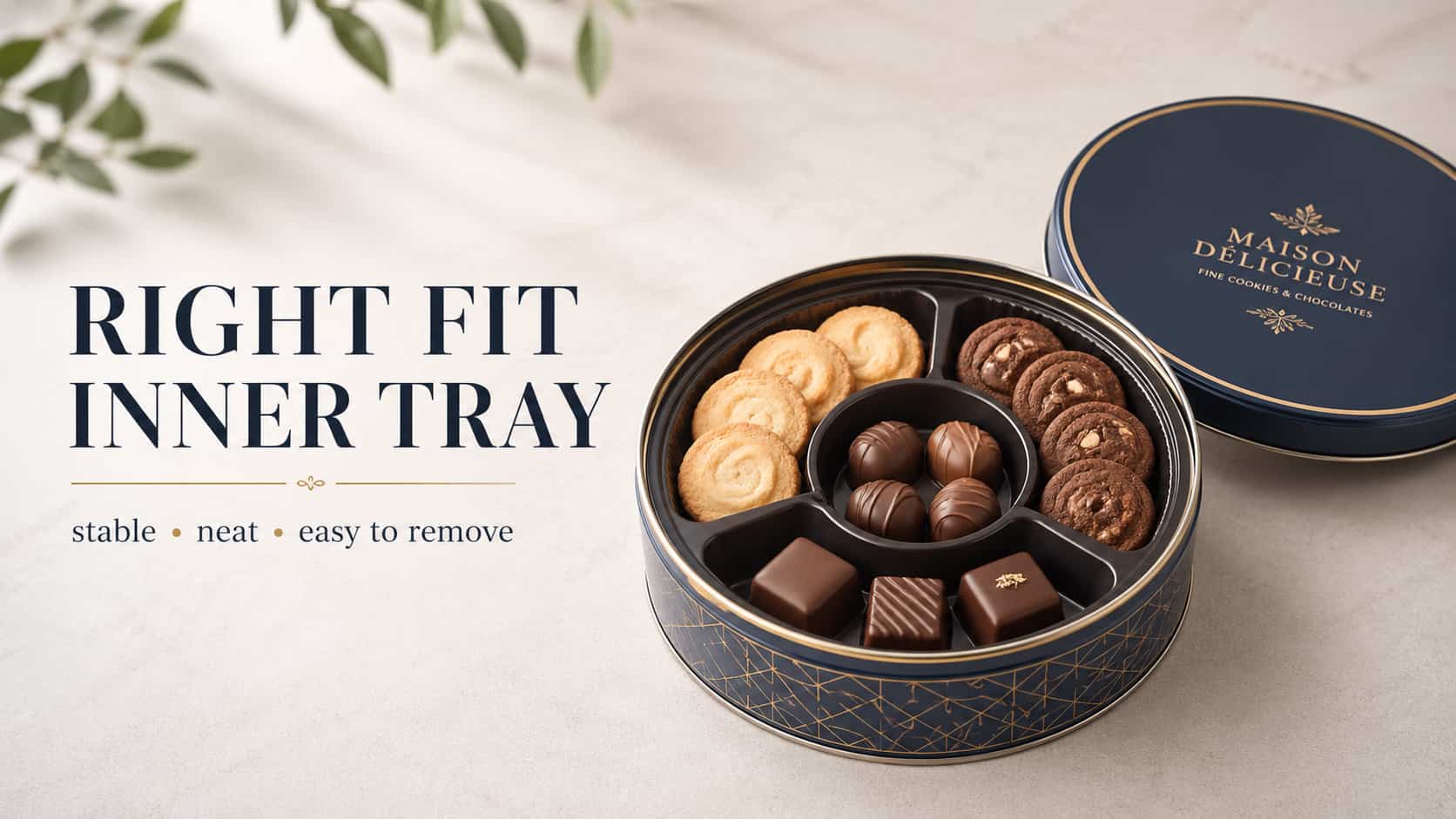
A right-fit inner tray does not mean the tightest possible tray.
This is a common misunderstanding. Some buyers think a tray should hold the product very tightly. But if the fit is too tight, the product may be hard to remove, the tray may deform, and packing workers may need extra time during assembly.
A good inner tray for round tin packaging should meet several practical standards:
In short, the tray should feel like part of the packaging, not like something forced into the tin.
If the tray is too loose, it may move inside the round tin during shipping. The product may shift, collide, or look messy when the customer opens the lid.
This often happens when only the product size is considered, but the real inner diameter of the tin is not checked carefully.
For candy tins, cookie tins, chocolate tins, and tea gift tins, a loose insert can make the whole package feel less stable.
A tray that is too tight can also create problems.
During packing, workers may need more force to push the tray into the tin. For plastic tray inserts, this may cause deformation. For paperboard inserts, the edges may bend or wrinkle.
A tight cavity may also make the product difficult to remove. This is not good for premium packaging. Customers should not feel that they are fighting with the package.
This is one of the most common issues in round tin packaging.
The tray may look correct outside the tin. The product may also fit into the tray. But after placing both into the tin, the lid may not close smoothly.
This usually happens when the product height, tray thickness, and lid depth are not calculated together.
Before mass production, always check the real sample with the actual product inside the tin. Drawings are helpful, but they cannot fully replace physical fitting tests.
If the cavity is too shallow, the product may fall out of position during movement.
This is common for chocolates, biscuits, cosmetics, and small gift sets. The product may look fine during photography, but after shipping, the arrangement may change.
The cavity depth should match the product height, weight, and surface shape.
Different insert materials have different performance.
A thin plastic tray may be low cost, but it may not support a heavy product. A paperboard insert may look natural, but it may not hold small items as precisely as a molded tray. Foam can protect fragile items, but it may not be suitable for every product style.
The right material depends on product type, price level, display needs, safety requirements, and order quantity.
| Factor | Right Fit | Wrong Fit | Possible Cost Impact |
| Product stability | Product stays in position | Product moves during shipping | More breakage, repacking, or complaints |
| Lid clearance | Lid closes smoothly | Lid feels tight or cannot close | May need tray or tin size adjustment |
| Customer experience | Product is easy to remove | Product is stuck or hard to take out | Poor user experience |
| Appearance | Clean, centered, and organized | Messy or uneven after opening | Lower perceived value |
| Assembly | Easy and fast to pack | Workers need extra adjustment | Higher labor time |
| Material choice | Matches product weight and purpose | Too soft, too thin, or too rigid | More waste or redesign cost |
| Mass production | Stable fitting in bulk | Sample works but bulk packing varies | Delay or extra QC work |
This is why tray design should be checked early. A small fitting problem at the sample stage is easy to fix. The same problem after mass production can become expensive.
Cost is an important part of tray selection, especially for small brands, startup products, seasonal promotions, or trial orders.
There is no single cheapest solution for every project. The final cost depends on material, structure, tooling, quantity, labor, and packing method. But in general, you can use the following logic.
Paperboard inserts are usually a cost-friendly option for simple separation, product support, or gift set layout.
They are often used for tea tins, gift tins, promotional tins, and lightweight products. The tooling cost is usually lower than custom molded plastic trays because paperboard inserts are normally made by cutting, folding, or die-cutting.
Paperboard is a good choice when the product does not need very precise cavities.
Best for:
Tea gift sets
Lightweight products
Simple dividers
Eco-style packaging
Small or medium quantity projects
Possible limitation:
Less precise than molded plastic
May bend if the structure is weak
Not ideal for very heavy or irregular products
Plastic trays are common for chocolates, candies, cosmetics, small jars, accessories, and premium retail packaging.
They can be formed to match the product shape, which gives better positioning and a cleaner display. However, if the tray is fully customized, it may require a mold or forming tool. This means there may be an initial mold cost before mass production.
For larger orders, the mold cost can be spread across the total quantity. For small orders, the mold fee may make the unit cost feel high.
Best for:
Chocolate tins
Candy tins
Cosmetic tins
Premium gift packaging
Products that need fixed cavities
Possible limitation:
Custom mold may be needed
Higher setup cost than simple paperboard
Material thickness and food contact requirements should be confirmed
Foam inserts are useful when the product needs cushioning or stronger protection.
They are often used for fragile gifts, tools, accessories, or products that need a snug fit. Foam can be cut to shape, so it may not always require the same type of mold as plastic trays. But cost can still vary depending on thickness, density, cutting method, and quantity.
Best for:
Fragile items
Gift sets
Tools or accessories
Products that need cushioning
Possible limitation:
May not suit all brand styles
Material smell and safety requirements should be checked
Not always suitable for direct food contact
Pulp trays are often considered when brands want a more sustainable or natural packaging direction.
They can offer good support and cushioning, but the surface finish and tolerance may not be as sharp as plastic. For premium round tin packaging, sample checking is especially important.
Best for:
Eco-positioned products
Natural gift packaging
Products needing light cushioning
Possible limitation:
Higher tolerance variation
Surface may be rougher
Moisture resistance should be checked
No. Not all inner trays need a custom mold.
This is an important point for budget planning.
A simple paperboard divider usually does not need an expensive mold like a plastic tray. It may only need die-cutting tooling or a cutting layout.
For small orders, using an existing tin mold and a simpler insert structure may be more cost-effective than developing everything from zero.
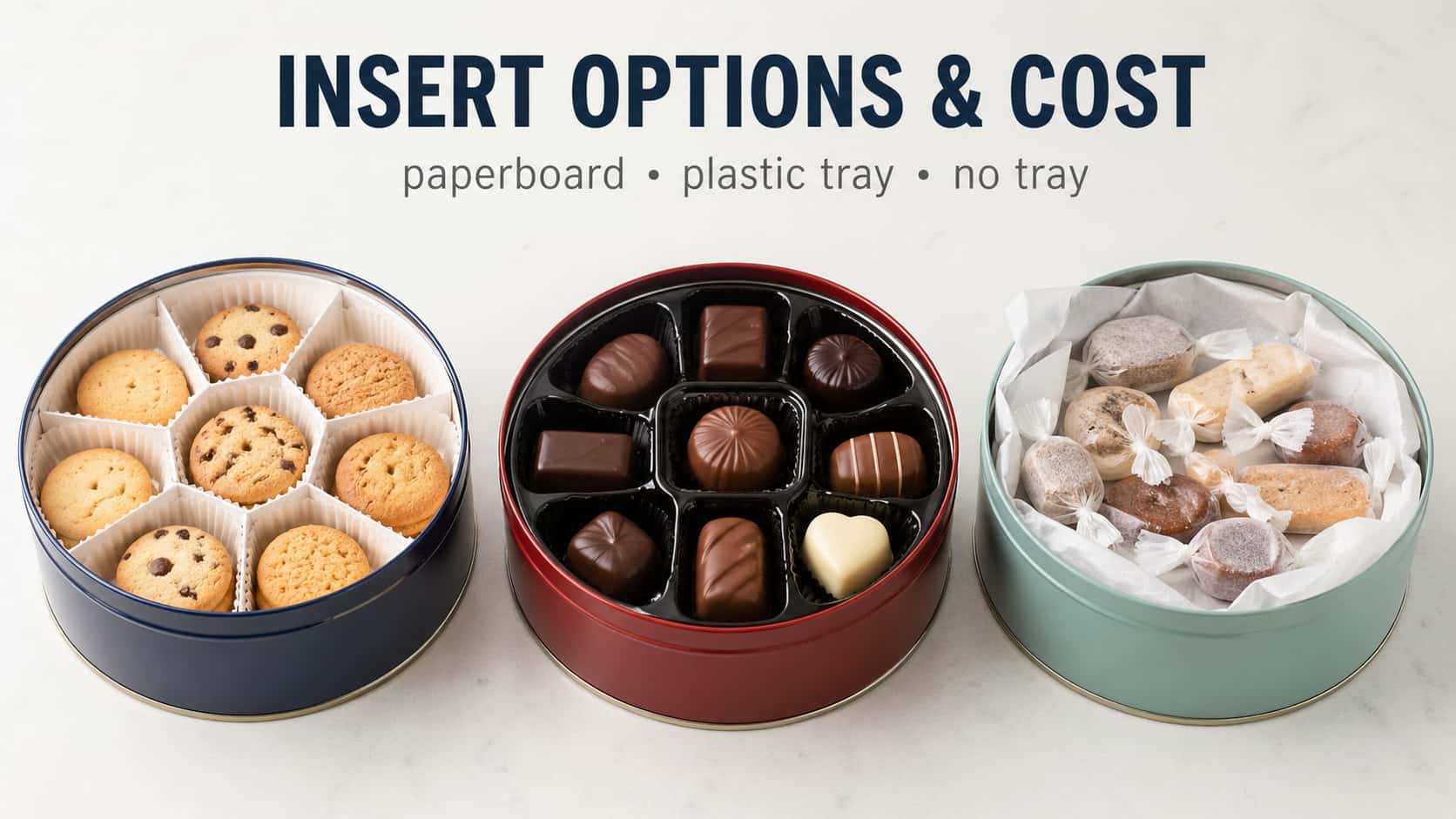
An inner tray is useful, but it is not always necessary.
Some round tin packaging projects can work well without a custom tray. In fact, removing the tray can reduce cost, shorten production time, and simplify packing.
You may not need an inner tray when:
The product already has individual packaging.
The product fills the tin space well.
The product is not fragile.
A slight movement inside the tin will not affect appearance or function.
The tin is used mainly as an outer gift container.
The budget is limited and the product does not require fixed positioning.
For example, if biscuits are already packed in a sealed bag, the bag can be placed directly into a round tin. If candies are individually wrapped, they may not need a molded tray. If tea bags are packed in sachets, a simple paper card or paper separator may be enough.
Other alternatives include:
Tissue paper
Glassine paper
Paper pads
Paper dividers
Soft paper wrapping
Small inner bags
Individual product sleeves
Corrugated paper support
These options may not look as structured as a custom molded tray, but they can be practical for certain products and budgets.
A good packaging solution is not always the most expensive one. It should match the product, order quantity, brand position, and sales channel.
In one round chocolate tin project, the customer wanted each chocolate piece to stay neatly arranged after shipping. The first sample used a tray that looked fine on the table, but after placing it inside the tin and shaking it slightly, the tray had room to move.
The problem was not the round tin itself. The issue was that the tray outer diameter was slightly too small, and the chocolate cavities were not deep enough for the product height.
The solution was simple. The tray diameter was adjusted closer to the tin’s internal size, and the cavity depth was improved so each chocolate piece sat more securely. After the revised sample, the product looked more stable inside the tin, and the lid still closed smoothly.
This kind of adjustment is common in custom tin packaging. It shows why real product samples, tray samples, and tin samples should be tested together before mass production.
Before choosing an inner tray, it helps to answer a few practical questions.
If the product is premium, fragile, or needs a clean display, a custom plastic tray or carefully designed paperboard insert may be worth the extra cost.
If the product is simple, individually packed, or budget-sensitive, a no-tray solution or simple paper insert may be enough.
For round tin packaging with inner trays, these details should be confirmed before production:
Tin inner diameter
Tin inner height
Lid depth
Product size and tolerance
Product weight
Tray material and thickness
Tray outer diameter
Cavity size and depth
Food contact requirements
Packing method
Carton arrangement
Sample fitting result
MOQ and tooling cost
The most important point is to test the actual product inside the actual tin with the actual insert. Checking only drawings can miss small but important fitting problems.
A professional tin box manufacturer should not only ask for the outside size of the tin. For a better packaging solution, the supplier should also understand the product and how it will be packed.
When sending an inquiry, it is helpful to provide:
Product photos
Product size
Product weight
Number of pieces per tin
Target tin shape and size
Preferred insert material
Order quantity
Food-grade or safety requirements
Brand positioning
Budget direction if available
With this information, the supplier can suggest whether to use an existing round tin mold, adjust the tin size, add a paperboard insert, develop a plastic tray, or remove the tray completely.
For many projects, the best result comes from balancing appearance, protection, cost, and production efficiency.
A good round tin package is not only about printing and metal finish. The inner structure also plays an important role.
The right inner tray can keep products stable, improve presentation, and make the package feel more professional. The wrong tray can cause shaking, poor lid closing, difficult assembly, or unnecessary cost.
Before choosing a tray, brands should compare different options: plastic tray inserts, paperboard inserts, foam inserts, pulp trays, and even no-tray alternatives. Not every project needs a custom molded tray. Not every product needs an insert at all.
At Tin Boxes China, we help customers develop custom round tin packaging for candies, cookies, chocolates, tea, cosmetics, candles, gifts, and promotional products. If you are not sure whether your product needs an inner tray, you can share the product size, quantity, and packaging idea with our team. We can help recommend a suitable round tin size, insert structure, and cost-effective production solution.
No. If the product is already individually packed, not fragile, or fills the tin space well, a custom inner tray may not be necessary. Paper wrapping, paper pads, or inner bags may be enough.
Usually yes, especially when a custom plastic tray mold is required. Paperboard inserts are often more cost-friendly for simple layouts, while plastic trays are better for precise product positioning and premium display.
Not always. Paperboard inserts and some foam inserts may only need cutting or die-cutting. Custom plastic trays usually need a forming mold if the shape or cavity layout is unique.
It depends on the food type, contact method, and market requirements. PET, PP, paperboard, and food-safe paper materials are commonly considered. The material should be confirmed based on the product and regulatory needs.
You can reduce cost by using an existing round tin mold, choosing a simpler insert structure, avoiding unnecessary custom plastic molds, increasing order quantity, or using paperboard or no-tray alternatives when suitable.
Obtenha as últimas informações e ofertas especiais


 Rede IPv6 suportada
 Português
 English
 Français
 Deutsch
 Español