
Two money tins can have nearly the same outside dimensions and work completely differently in use.
Last year a client sent us three samples with almost identical outside measurements: all around Ø80 × 95 mm. The first couldn't accept a folded €20 note — the slot was wide enough, but the note caught on the lid rim as it went in. The second swallowed notes easily, but when filled with €1 coins it weighed nearly 2.8 kg and the base seam started showing a slight bulge after a week on a retail counter. The third handled both coins and notes, but when we tried to empty it, notes were trapped under the coin pile and the customer had to shake the tin upside down.
All three were unusable. But the reasons were completely different.
That is the core of money tin sizing: outside dimensions tell you almost nothing about whether a tin will work. You need to test with the actual coins, the actual notes, the actual folding pattern and the actual way people will fill and empty it.
This guide explains how to do that — from defining the currency and load, through understanding what "capacity" actually means, to approving a filled sample before bulk production.
Start with the deposits the tin is expected to receive.
A retail savings tin for occasional loose change has a different brief from a countertop collection tin emptied every Friday. A children's savings tin has a different opening requirement from a hotel reception tip jar. The saving or collection period defines the load you need to test, and how often the closure will be operated.
For coins, list the denominations the product must accept. For banknotes, identify the relevant denominations and versions, and specify whether users will insert them flat, folded or rolled. For a mixed-cash tin, set a representative number of coins and notes and an order of insertion. An alternating sequence — coin, note, coin, note — is often more representative than loading all the coins first and all the notes on top.
Here is a brief format we use with clients at the quoting stage:
| Intended use | What to confirm first |
| Everyday coin savings | Coin mix, expected count, frequency of emptying |
| Note savings | Note denominations, fold method, internal arrangement |
| Mixed coins and notes | Content ratio, deposit sequence, retrieval convenience |
| Counter or event collection | Emptying cycle, loaded weight, handling method |
| Children's savings | Coin size vs slot, opening force, lid security |
One detail that often gets missed: how often will the tin be opened? A tin that is opened once a year can have a tight lid. A tin that is opened every day for collection needs a closure that stays smooth after hundreds of cycles. We've seen a hinge on a counter collection tin fail after three months because the design was never tested for daily operation.
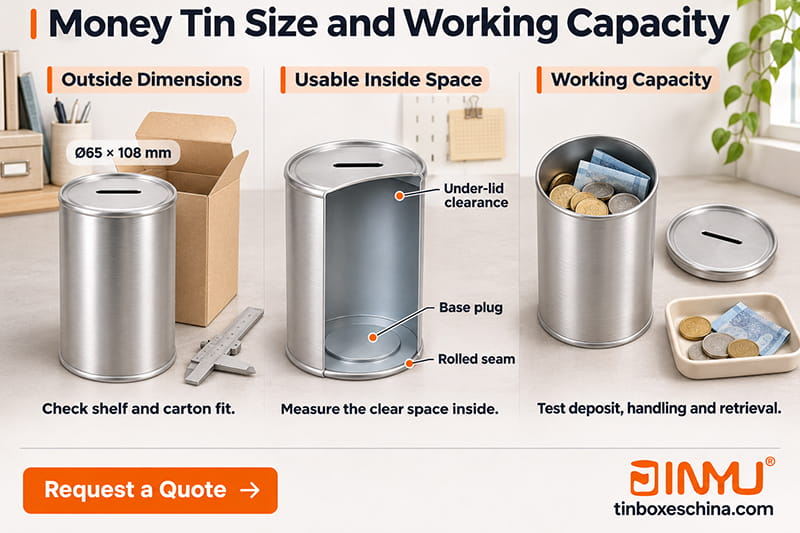
Ask the supplier to specify which dimensions are external and which are measured inside the finished tin.
For a round money tin, use diameter × height. For a rectangular tin, use length × width × height. On an irregular shape, identify the usable space at the points that govern fit and access.
| Measurement | What it tells the buyer |
| Outside dimensions | Whether the tin fits a shelf, display or retail carton. |
| Usable inside dimensions | How much space is available around inward-projecting seams, closures and fittings. |
| Internal volume | How much space the cavity encloses, typically expressed in millilitres. |
| Working capacity | The number of coins and notes accepted under defined deposit, handling and withdrawal conditions. |
| Monetary value | The total face value of the specific load. |
| Loaded weight | The combined weight of the finished tin and the contents it must carry. |
For example, Jinyu lists a cylindrical money tin at Ø65 × 108 mm. That size helps shortlist a model. A drawing or sample can then show the usable diameter, clearance under the lid and the opening available for retrieving notes. The catalogue size alone does not establish a coin count or cash value.
A detail we've learned from actual projects: On a Ø65 mm tin with a base plug, the usable inside diameter is closer to 58–60 mm once the plug flange and the rolled base seam are accounted for. That 5–7 mm difference sounds small, but it changes how many coins fit in a single layer — and whether the bottom layer sits flat or tilts.
If the buyer only has a "saving goal" in mind, agree which denominations to use when translating that goal into a sample load. A €200 target made of €1 coins is a very different test from a €200 target made of €2 coins.
The face value and nominal weight of a proposed coin load can be calculated before sampling. For mixed denominations, multiply each count by its face value or unit weight and add the results.
Worked example: 100 €1 coins and 50 €2 coins.
The European Central Bank lists unit weights of 7.50 g for €1 and 8.50 g for €2. The proposed load is worth €200 and has a nominal coin weight of 1,175 g. Add the empty tin's weight — around 120–150 g for a Ø80 mm tin — for an initial estimate of the total. ecb.europa.eu
That calculation defines a load to evaluate. It does not show that the coins fit a particular tin.
Where theory and practice diverge: We worked with a UK client last year who calculated their planned load at 1.2 kg based on the ECB unit weights. When we actually filled the tin, the loaded weight came to 1.38 kg. The extra 180 g came from the fact that coins don't pack perfectly — there's air between them, and the tin itself was heavier than the catalogue figure suggested. If they had sized the tin based on the calculated weight alone, the loaded tin would have been uncomfortably heavy for the intended retail channel.
To compare capacity, use the same coin mix and deposit method for each candidate.
| Deposit method | What it tells you | When to use it |
| Natural drop, one coin at a time | Realistic daily-use capacity | For consumer savings tins |
| Drop then shake to settle | Maximum practical capacity | For tins that will be filled and stored |
| Pre-loaded stacks through open lid | Theoretical maximum, not realistic | Only for understanding absolute limits |
If users normally drop in coins one at a time, start there. A sample pre-loaded with stacks through an open lid answers a different question: how much can be packed inside under those conditions. If the intended routine includes settling the coins, record that as a separate test.
A concrete comparison from our workshop: We tested the same Ø80 × 95 mm tin with 500 × €1 coins using two methods.
Natural drop only: 187 coins fit before the lid would no longer close cleanly. Weight: 1.52 kg including tin.
Drop then gentle shake every 20 coins: 234 coins fit. Weight: 1.87 kg including tin.
That's a 25% difference in capacity from a 10-second shake during filling. For a brand selling "fills up to €250," that difference determines whether the claim is honest.
When a product carries a claim such as "holds €200," state the denominations and load used to support it. A different mix can change the space and weight required for the same saving goal.
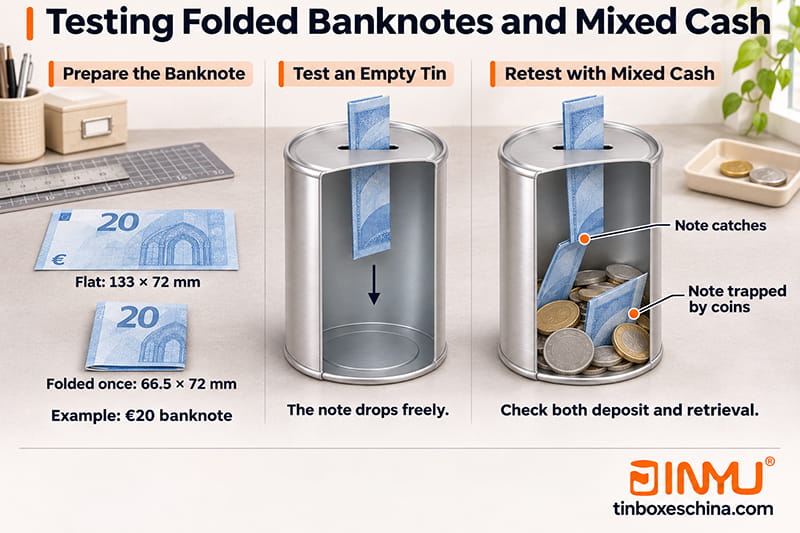
A money tin for notes needs room for the note as it goes through the slot and after it falls into the cavity. Check the leading edge, the thickness at the fold and the clearance below the lid.
A note that fits through an empty slot can still catch on notes already inside or be difficult to retrieve through a small outlet.
The ECB lists the Europa series €20 banknote at 133 × 72 mm. The table below uses that note to show how fold direction changes its nominal footprint.
| Intended deposit | Nominal €20 note footprint | What to check on the sample |
| Flat | 133 × 72 mm | The intended entry path and space for the note to settle. |
| Fold once to halve the longer dimension | 66.5 × 72 mm | Which edge enters first and whether the fold catches. |
| Fold once to halve the shorter dimension | 133 × 36 mm | Whether the longer edge and actual insertion angle fit the design. |
| Fold once in each direction | 66.5 × 36 mm | Clearance for the thicker fold and access when emptying the tin. |
What we see in practice: Most European consumers fold a €20 note once along the long edge, giving a 66.5 × 72 mm footprint. That folded note needs a slot at least 68–70 mm wide to slide in without catching, and about 4–5 mm of clearance below the lid for the fold to pass through.
We had a German client whose tin had a slot measuring 65 × 4 mm. The folded €20 note was 66.5 mm wide — just 1.5 mm too wide. It would go in if you angled it, but the edge would catch and crease. The client hadn't tested with actual folded notes before approving the design. We widened the slot to 72 mm and the problem disappeared.
Use notes in representative condition. New notes are stiffer and occupy more space; worn notes fold tighter but may jam more easily.
For mixed cash, check deposits both before and after coins accumulate, then empty the tin as a user would. Record whether coins trap the notes or whether the notes have to be squeezed or pulled through the outlet.
A mixed-cash failure we investigated: A client in the Middle East packed a promotional money tin with a mix of coins and folded notes. In the lab, coins went in fine. Notes went in fine. But when both were loaded in the intended 60:40 ratio, the notes slid down the side of the coin pile and wedged between the coins and the tin wall. Retrieval required turning the tin upside down and shaking it — not acceptable for a gift product. The fix was a simple internal divider that kept notes in their own channel. It added about $0.08 per unit but solved a problem that would have generated complaints.
A round tin can be shortlisted by diameter and height; a rectangular format gives two straight internal spans to compare against the intended note orientation.
| Shape | What to compare |
| Round | Diameter, height, top opening, stability on counter |
| Square / rectangular | Internal length and width, note orientation, packing efficiency |
| Tall and narrow | Stability when full, centre of gravity, handling |
| House, postbox or novelty shape | Actual internal contour, structural intrusion, retrieval path |
| Small / medium / large series | Each model's specific dimensions and test results |
A packing fact worth knowing: On the same pallet, rectangular tins typically pack 20–30% more units per carton than round tins of similar capacity. A round Ø80 mm tin leaves gaps in a square carton; a square 80 × 80 mm tin uses the corner space. For high-volume export orders, this difference can outweigh a small aesthetic preference for the round shape. We always calculate carton utilisation before recommending a shape for a volume order.
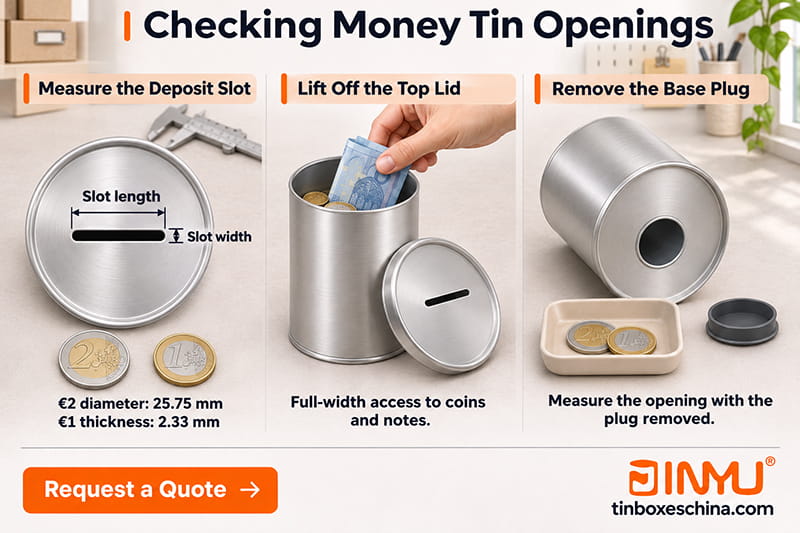
On a conventional narrow slot, use the largest intended coin diameter to screen the clear slot length, and the greatest intended coin thickness to screen the clear slot width.
The limiting dimensions may come from different coins: ECB specifications list €2 at 25.75 mm in diameter and 2.20 mm thick, and €1 at 23.25 mm in diameter and 2.33 mm thick.
Note the subtlety: The €2 coin is wider but thinner. The €1 coin is narrower but thicker. If your slot is designed around the €2 coin's diameter, you also need to check the €1 coin's thickness — a 2.5 mm slot that accepts the €2 coin may jam on a slightly bent €1 coin.
Check the exit separately. A removable top can provide broad access; a base plug creates a smaller outlet whose clear dimensions should be measured with the plug removed. If a tin has a fixed top, ask the supplier to demonstrate the intended method of emptying it. See the guide to money tin lids, shapes and clear windows for the main closure options.
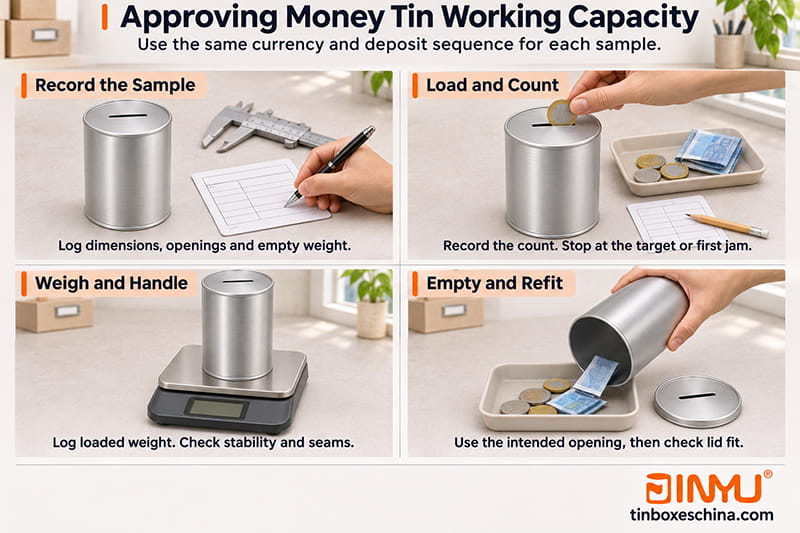
Compare candidate tins using the same currency, deposit sequence and acceptance criteria. Agree what will count as a usable load before starting: the tin should accept the planned contents, handle as intended and empty through the specified opening.
Record the sample. Note the model, revision, inside and outside dimensions, clear openings and empty weight.
Load as intended. Use the agreed coins, note folds and deposit sequence. Record counts and any interference as contents accumulate.
Record the stopping point. Stop at the planned load or when normal deposits are interrupted. Record the count reached and any problem observed. A pass at the planned count verifies that target once handling and withdrawal also pass; it does not establish a maximum.
Weigh, move and empty it. Check stability and the condition of the body, base and closure under the agreed handling conditions. Confirm that coins and notes can be retrieved as intended, and that any reusable closure fits again afterwards.
Here is a completed test record from one of our recent projects — a Ø80 × 95 mm tin intended for the German market:
| Model | Inside dims | Currency and method | Planned load | Verified load | Loaded weight | Handling result |
| JY-MT-080 | Ø72 × 84 mm | €1 coins, natural drop | 150 coins | 163 coins before slot jam | 1.38 kg | Stable on counter; base seam intact after 1 week |
| JY-MT-080 | Ø72 × 84 mm | €20 notes, folded once | 20 notes | 22 notes before lid pressure | 0.42 kg (notes only) | Notes retrieved easily via base plug |
| JY-MT-080 | Ø72 × 84 mm | Mixed 70:30 coins:notes | 120 coins + 15 notes | 118 coins + 14 notes | 1.21 kg | Notes trapped under coins; divider recommended |
That last row is the reason we now recommend an internal divider for any mixed-cash tin where notes exceed 20% of the volume. Without it, retrieval becomes a two-handed shaking operation.
For a first comparison, choose two finished models and one target currency. Run the relevant coin, folded-note and mixed-cash scenarios on both. Keep photos of the slot, loaded sample and withdrawal method with the result. If the slot, base or closure changes after approval, repeat the checks affected by that change.
Send suppliers the same brief so they can recommend a model and quote against comparable requirements:
Destination market and the coin or note denominations to accept.
Target counts, note fold and any mixed-cash deposit sequence.
Maximum outside dimensions, preferred shape and display or packing limits.
Deposit and withdrawal methods, emptying frequency and expected handling at the planned load.
Quantity by design, artwork, retail packing and delivery requirements.
Ask for the proposed model's dimensions and opening details, and agree what the filled sample must demonstrate.
Explore Jinyu's money tin boxes and share your intended load and size limits to help narrow the available formats. We can check our existing mould library — over 3,000 shapes and sizes — and suggest the closest match before considering new tooling.
The cash value depends on the denominations and quantities the tin accepts under the intended conditions. Test the load with a defined coin and note mix, then add the face values of the contents to report the amount. State the coin mix alongside the value — €200 in €1 coins is a very different tin from €200 in €2 coins.
Start with the target note and its intended fold. A €20 note folded once along the long edge measures 66.5 × 72 mm and needs a slot at least 68–70 mm wide with 4–5 mm clearance below the lid. Check that the folded note can enter in the intended orientation, settle in the available cavity and be retrieved. Repeat the test with notes already in the tin.
Yes, if the openings and cavity suit both and the proposed mix can be deposited and removed as intended. Test the mix directly — separate coin and note trials will not show how the two interact inside the tin. For mixes above 20% notes, an internal divider is usually worth adding.
No. A larger tin with a thick base plug may have less usable internal height than a slightly smaller tin with a flat base. And a tall narrow tin may hold fewer coins in a single layer than a short wide tin. Capacity depends on usable space, not outside dimensions.
Test a sample that represents the quoted design. Record the contents, loading method, count, total weight and results of the handling and withdrawal checks. Use that record to approve the model and agree when a design change requires retesting. We recommend testing at least two models side by side with the same load.
As a general guide, a tin that will be carried regularly should stay under 2–3 kg loaded. Between 3–4 kg, consider a handle or a smaller size. Above 4 kg, the tin becomes a two-handed object and needs a stronger base structure and a wider retrieval opening.
In our tests, shaking the tin every 20 coins increased capacity by roughly 25% compared to natural drop alone. Natural fill is what a consumer experiences day to day. Shaken fill is what you get when a tin is deliberately packed. State which method your capacity claim is based on.
Choosing a money tin size is not a matter of picking the biggest tin on the shelf. It's a matter of testing the actual contents against the actual openings, the actual handling and the actual loaded weight.
Start with the currency. Define the fold. Test with real coins and real notes. Weigh the loaded tin. Approve only what you've held in your hand and tried to empty.
If you're developing a money tin for coins, notes or mixed cash, send us your target currency, expected load, fold method and destination market. We'll recommend suitable existing moulds, prepare a filled sample for testing, and provide a capacity record you can use as the basis for your order.
Custom printed production starts from 5,000 pieces per size and design. Sampling takes approximately 7–10 days, with mass production 25–35 days after sample approval.

Obtenha as últimas informações e ofertas especiais


 Rede IPv6 suportada
 Português
 English
 Français
 Deutsch
 Español