
Two rectangular tin money boxes can look identical on a shelf. One has a lid that lifts off; the other has a fixed top and a round plug underneath. The buyer who approves only the front view may miss the difference until the first sample arrives.
Start by deciding who will take the money out, how often they will do it, and whether the tin must be usable afterwards. That decision narrows the choice of opening designs before you select a shape, print the artwork or add a clear window.
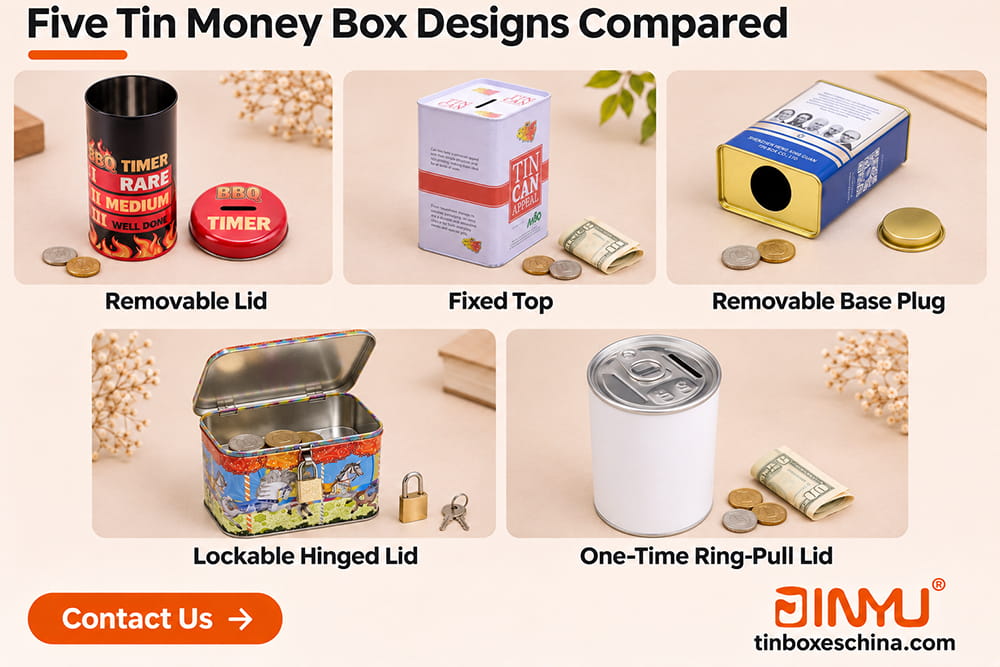
Ask the supplier to demonstrate the tin closed, the withdrawal opening exposed and any lid or plug removed. Ensure that the photos are of the quoted version.
| Design | How the money goes out | Can it be recycled? | Best fit | What to check on the sample |
| Removable lid | Remove the whole top lid | Yes, if the lid is meant to be refitted. | Retail ranges and branded gifts that users will empty often | Ease of removal, even fit and retention when full |
| Fixed top | By means of final opening as specified or by separate opening if fitted | Depends on the remainder of the design | Projects needing a permanent top, including models with no routine withdrawal opening | Examine the underside and sides. Confirm the manner in which the money is to be retrieved |
| Removable base plug | Remove the plug and empty out through the base opening | Yes, if plug can be replaced | Designs that require an uninterrupted top, except for the coin slot | Plug retention, clear opening size and if the tin sits flat |
| Lockable hinged lid | Unlock and lift the hinged lid | Yes | Projects where a key holder controls access | Hinge travel, lock alignment and opening with the supplied key |
| Pull taps lid single use | Lift the ring to peel open the end panel | One-time design – the original end does not re-seal | Gifts and Promotions; Opening planned - end | Pull-ring operation; Access after opening and the exposed edge |
A money tin with a removable lid allows the user to remove the lid in its entirety, empty the contents and replace it.
Open and close a filled sample several times. Make sure the lid still sits evenly and stays in place during normal handling. A right fit on a bare sample may act differently when the tin is loaded.
The top is fixed. This is how the top is attached. It doesn't tell you if there's an outlet somewhere else. If the brief calls for a tin without a normal withdrawal opening, ask the supplier to indicate the intended method of final opening. Write it into the specification and ask for a demo before approving the design.
Ask the actual diameter of the opening with the plug removed. The outside diameter of the plug does not tell you what will flow through the hole. Empty the sample with the actual coins to be used, replace the plug and test for looseness or wobble when the tin is set down.
The box has a hinged tin with a lock and key, and the key holder has a repeatable way to open the box. Specify if it is built with an outside padlock or an inside lock. Make sure the lid closes and the latch lines up without having to press the sides in to make it so. Verify the number of keys per unit.
The ring-pull design provides the user with a dedicated way of opening the tin when the saving period is over. One example is the VBS ring-pull money box that cannot be reclosed after opening it.
Ask for a demo of a new sample and then look at the edge and the access to the content. Open a sample for your reference together with the closed sample for approval.
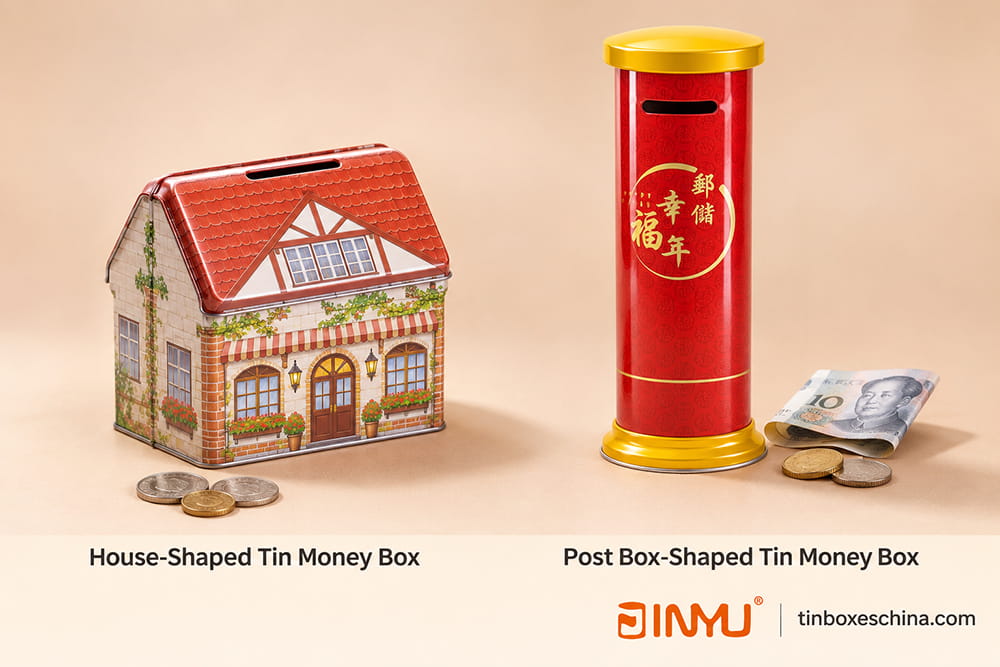
A post box money tin makes a good souvenir or theme where posting a coin is part of the fun. Ensure the slot is visible and accessible at the desired display height. If the design is tall, check its stability when empty and partially filled.
A The house-shaped money tin has separate areas for artwork on the roof and walls. Ask if the roof is fixed, lifts off or opens on a hinge. If it is fixed, confirm where is the money coming out. If the coin slot is on a sloped panel, test insertion at the angle a user would actually approach it.
If it’s a custom shape, compare the desired outline to existing tooling before approving artwork. For example, a bottle shaped body can be used for a themed gift, but a change to the profile can change the lid, the base and the body as well. Request the print template and carton layout suggestion to check artwork alignment and units per carton together.
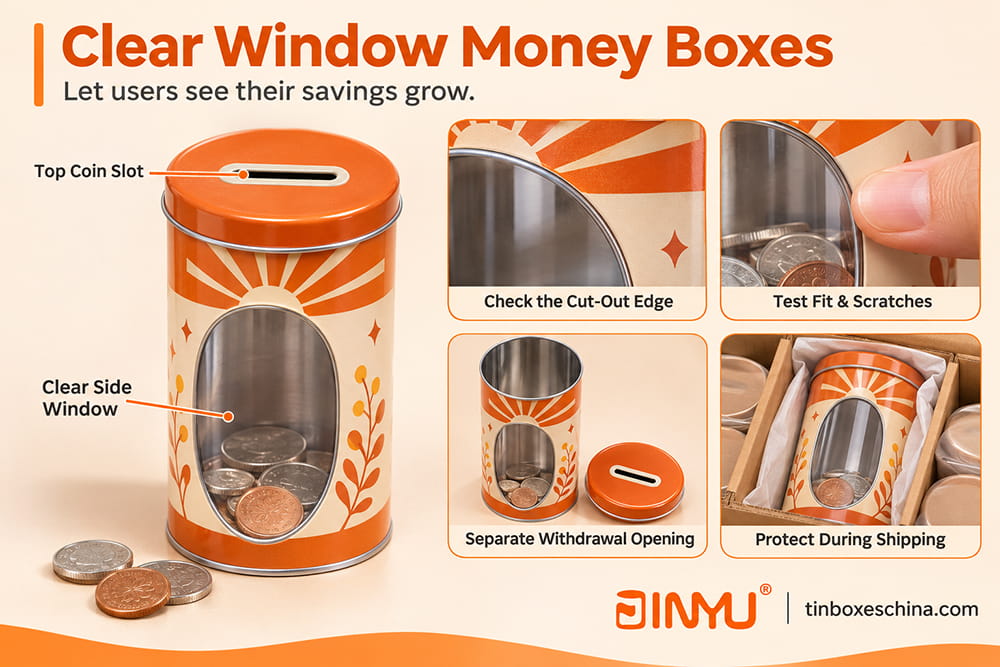
The rest of the tin is printed artwork but users can watch through a clear window as their coins pile up inside. An example is a round tin money box with a side window and a coin hole on the lid. The window and the withdrawal opening can be defined separately.
Prevous sampling and agree on the opening size and location, the clear insert material and how it is held in place. Inspect the cut-out edge and the visible surface, then load the tin and treat it like a user would. Check the insert for movement, any scratches where the coins are rubbing against it, and any change in the fit around the opening. Look at the protection for the window when the units are packed for shipment.
Please supply a photo or sketch of the deposit slot and cash-out opening to the supplier and not just the front artwork. Include:
Ask what parts can use existing tools and what parts need changes. If a quote assumes a body that already exists, check to see if it includes the necessary lid, base and window work. Approve the assembled sample by depositing real coins, moving the filled tin and taking out the money as planned.
Yes, if it has a separate reusable outlet, such as a removable bottom plug. Confirm the opening method on the drawing and sample.
A bottom plug keeps the top in place and is useful when the opening underneath is large enough to empty the intended coins. A removable lid is more practical when users need broad access or expect to empty the tin frequently.
No. The roof may be fixed. Ask for an opened product photo and a bottom view so the withdrawal point is clear before you approve the design.
Sometimes. The supplier needs to check the location against the formed body, seams and printing area, and confirm how the insert will be fitted. Ask whether the existing body tooling can be retained and whether the window needs a separate cutting or assembly operation.

Obtenha as últimas informações e ofertas especiais


 Rede IPv6 suportada
 Português
 English
 Français
 Deutsch
 Español