
A custom printed cookie tin may look simple once it reaches a shelf: a finished box, clean artwork, a food-safe interior, and a lid that closes properly. In production, however, that result depends on a chain of decisions that starts long before printing and continues well after the first sample is approved.
Artwork, tinplate grade, inner lacquer, print compatibility, curing control, forming accuracy, seam protection, and packing discipline all affect whether the final tin is merely attractive or truly production-ready. For bakery brands and import buyers, the real question is not how to make one beautiful sample. It is how to make the same tin correctly, safely, and consistently at scale.
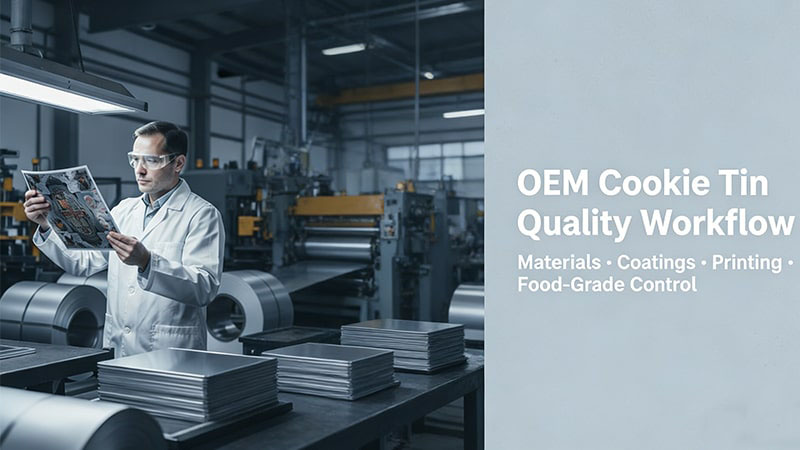
Many packaging discussions start with the design file, but in practice a cookie tin project starts earlier. Before artwork can be translated into print plates, the factory needs to know the tin structure, the tinplate specification, the interior coating system, the intended food-contact conditions, and how the box will be formed after printing.
That matters because metal packaging behaves differently from paper packaging. A strong design can still fail if the substrate is wrong, if the coating is mismatched to the product, or if the printing system cannot survive baking, stamping, curling, and packing.
| Project element | What it controls | Why it matters before printing begins |
| Tinplate grade and coating weight | corrosion resistance, forming behavior, long-term durability | A print-perfect surface is not enough if the metal or tin coating is unsuitable for export or humid storage conditions |
| Structural design | lid fit, seam position, edge exposure, stacking strength | Artwork has to work with panel breaks, curl lines, hinges, and embossed zones |
| Inner lacquer or food-contact coating | food safety, odor neutrality, barrier performance | Cookie tins need interior systems that are food-safe and stable under production heat |
| Printing and curing route | color fidelity, adhesion, finish durability | The chosen finish has to survive later forming and packing, not just look good on a flat sheet |
Metal is not a neutral canvas. Color can shift, highlights can behave differently, and fine details may not survive in the same way they do on a screen proof or paper mockup. That is why the artwork phase for cookie tins usually involves more than file checking. It often includes panel mapping, print margin adjustments, white-base planning, embossing registration, and decisions about where gloss, matte, foil, or spot effects should be used.
Cookie tins with deep embossing, complex lid geometry, or heavy side-wall curvature are especially sensitive. Graphics must be planned around the physical behavior of the box, not just the visual intention of the design.
Main graphics, legal copy, barcode areas, and fold or seam zones are positioned around the actual box geometry.
Metal surfaces often need white underlayers so colors stay bright and consistent rather than dull or grey.
Embossing, foil, spot varnish, and special finishes must align precisely with the printed image.
Artwork has to account for curling, bending, and shaping so graphics do not distort after forming.
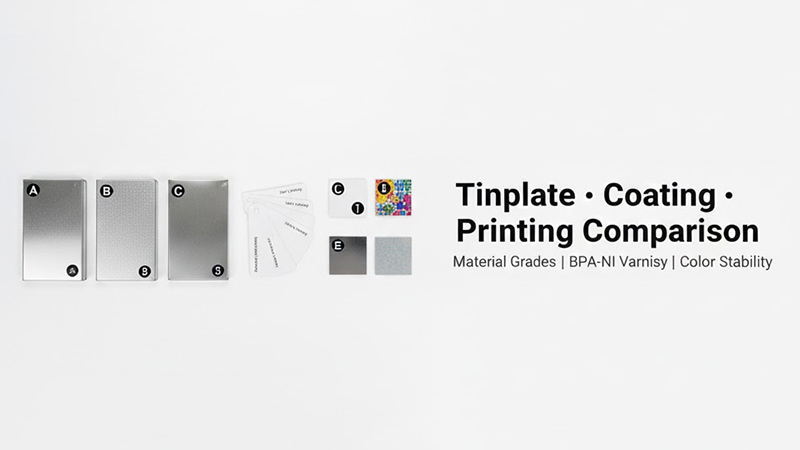
For biscuit and cookie tins, food-grade compliance is built into the material and printing route from the beginning. The inner coating, the inks, the varnish system, and the curing process all need to support food-contact safety. This is one reason a cookie tin project cannot be treated like a generic decorative box.
In practice, factories may work with food-grade lacquer systems such as BPA-NI or other approved coatings depending on market requirements. What matters is not only the claimed coating type, but also whether it is applied evenly, cured properly, and matched to the product category and destination market.
| Food-contact area | What should be controlled | Why it matters |
| Interior coating | approved lacquer type, coverage continuity, odor neutrality | Cookies and biscuits should not be affected by migration, odor, or exposed metal at vulnerable zones |
| Printing inks and varnishes | food-grade suitability and correct curing | A visually attractive finish is not enough if the chemistry is unstable or improperly processed |
| Heat exposure in production | controlled baking and curing profile | Under-cured layers can weaken adhesion or leave the finish vulnerable later in production |
| Market compliance | matching the project to FDA, EU, LFGB, or destination requirements | Buyers often need compliance that aligns with their sales region, not just a generic “food-grade” claim |
A cookie tin is rarely the whole preservation system by itself. For many biscuit projects, shelf performance also depends on the closure design, the fold quality of the body and lid, and whether the brand uses additional preservation support such as an inner bag, desiccant, or a more protective sealing structure.
This is particularly relevant for premium biscuits, gift collections, export shipments, and products that may sit longer in retail or warehouse environments.
| Support feature | What it can improve | Where it is most relevant |
| Double-folded or better-controlled body/lid fit | closure stability and reduced air entry at the opening line | Gift tins, premium biscuit tins, export formats |
| Improved sealing details or liner systems | better support for freshness-sensitive products | Higher-value biscuits or long shipping routes |
| Inner bag or pouch | more direct barrier protection for the biscuits themselves | Projects where tin alone is not enough for shelf-life goals |
| Desiccant or moisture-control support | lower humidity risk in the pack system | Humid climates, export, or long-retail-life projects |
| UV-protective exterior coating | stronger surface durability and better print stability | Retail environments with stronger light exposure |
Once artwork is finalized and metal sheets are prepared, printing begins. At this stage, many buyers focus on color and sharpness, but factories know the next issue is usually durability. A cookie tin that looks excellent immediately after printing can still fail later if the ink film, varnish, or lacquer has not been cured correctly.
That is why curing matters so much. The coating system needs enough time and control to bond, stabilize, and resist later handling. If curing is rushed, the risk may not appear on the press line. It may appear later when sheets are cut, edges are curled, lids are formed, or finished tins are packed while surfaces are still vulnerable.
Nearly any factory can produce a very attractive sample in low quantity. The more important question is whether the same finish, alignment, and durability can be repeated tens of thousands of times without drift, scratches, soft varnish, or forming-related defects.
Sample approval is where expectations are set, but it is often treated too narrowly. Buyers naturally look first at color, graphics, and finish. Those matter, but a cookie tin sample should also confirm the practical behavior of the project: lid fit, curl consistency, embossing depth, seam neatness, coating coverage, and whether the approved finish can realistically survive scaling.
| What buyers often check first | What should also be checked before approval |
| Color match, sharpness, visual appeal | print adhesion, curing stability, forming tolerance, seam finish, lid behavior, and coating continuity |
For larger orders, it is often more valuable to ask whether the factory can repeat the sample standard consistently than whether the first sample is flawless in isolation.
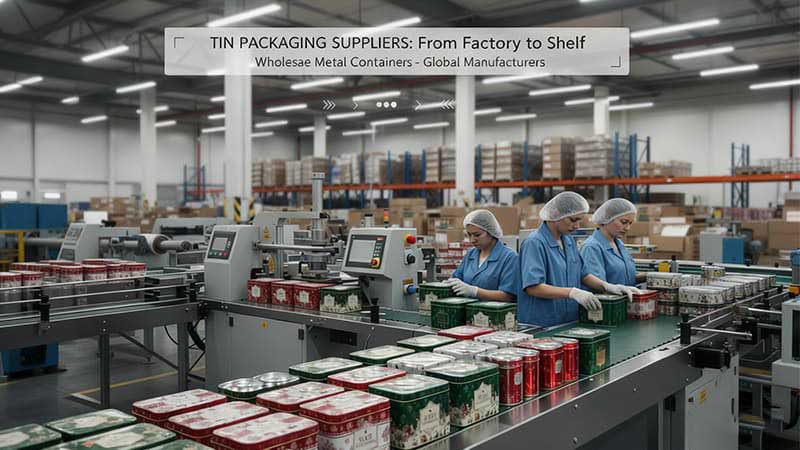
Mass production introduces pressures that sampling does not fully reveal. Print plates run longer, sheets move faster, forming lines run continuously, and schedule pressure becomes real. During busy seasons, some of the biggest quality risks come not from dramatic machine failure, but from small losses of discipline: incomplete curing, insufficient cooling time, rushed handling, or packaging while varnish is still vulnerable.
| Production stage | Typical hidden risk | Why buyers should care |
| Sheet cutting and feeding | registration drift, edge damage, scuffing | Early damage can show later as visual defects or poor forming |
| Printing and varnish application | color variation or unstable finish build | Retail consistency is harder to maintain at volume than in sampling |
| Curing and cooling | soft surface, weak adhesion, delayed scratching | Problems may appear only after later processing or shipment |
| Forming, curling, and assembly | stress at embossed zones, edges, or seam areas | Mechanical weakness often appears here, not on flat sheets |
| Packing and export handling | surface abrasion, denting, corner damage | A beautiful batch can still fail commercially if packed poorly |
For this reason, reliable OEM factories focus on repeatability rather than isolated perfection. In premium tin packaging, repeatability is often the more meaningful definition of quality.
Durability problems in biscuit tins are often discussed too late, usually only after rust or edge degradation appears. In reality, corrosion resistance is determined upstream by the metal system, the coating system, and whether vulnerable areas are properly protected during manufacturing.
Rust rarely begins at the middle of a beautifully printed panel. It more often begins at side seams, folded edges, cut exposures, or places where the lacquer system is weak, interrupted, or mismatched to the environment.
| Durability factor | Why it matters | Where problems often begin |
| Tin coating weight | Higher or more suitable tin coating can improve resistance to early oxidation | Projects using lower protection levels in more demanding storage or export conditions |
| Interior lacquer choice | Gold lacquer and clear lacquer may differ in barrier performance depending on formulation and application | When coating continuity is weak or the chosen system is not matched to biscuit use |
| Seam and edge protection | Flat panels are not usually the highest-risk zones; seams and exposed edges are | Side seams, curl starts, corner transitions, and internal edge lines |
| Salt spray or corrosion testing | Testing reveals whether the protective system is only theoretical or actually robust | Failures often expose seam weakness, lacquer gaps, or coating inconsistency |
In other words, rust is usually a system failure rather than a single-point defect. It often reflects a combination of tin coating choice, lacquer quality, edge handling, seam treatment, and insufficient durability testing.
Because a cookie tin project combines printing, food-contact compliance, metal forming, and mass-production discipline, supplier selection should go beyond price and sample appearance.
| Factory capability | What buyers should look for |
| Material and coating understanding | clear explanation of tinplate options, inner lacquer systems, and food-contact suitability |
| Sampling discipline | ability to discuss print adaptation, approval logic, and likely scale-up risks rather than just visuals |
| Mass-production repeatability | evidence of process control at printing, curing, forming, and packing stages |
| Communication quality | practical answers about lead time, risk points, tolerances, and export packing, not generic claims |
| Durability and compliance mindset | comfort discussing seams, lacquer continuity, testing, and destination-market requirements |
Custom tins still matter because they deliver more than short-term shelf impact. When executed well, they combine protection, reuse value, tactile quality, and brand memory in one object. A carton may be discarded immediately. A metal tin is often kept, reused, displayed, or repurposed. That changes how long the packaging continues to work for the brand.
For some brands, that also improves the real value of the pack over time. The tin is not only a cost line in production. It becomes part of the retail experience and, in some cases, part of the customer’s home environment long after the biscuits are gone.
A custom printed cookie tin succeeds when artwork, metal, coatings, printing, forming, and packing are treated as one coordinated process. The strongest factories do not rely on end-of-line inspection to rescue weak decisions made earlier. They build quality forward, from material selection and print planning to curing, seam protection, and export packing.
That is why the most useful manufacturing partner is not simply the one who can make a good-looking sample. It is the one who understands how to turn that sample into a repeatable, food-safe, durable mass-production result.
 Related reading
Tinplate cans remain a cornerstone in food packaging due to their ability to preserve freshness, flavor, and safety during storage, transportation, and sales.......>> Read More
Tinplate printing belongs to the domain of specialty or metal printing, distinct from conventional paper printing in both process and equipment......>> Read More
Tinplate—essentially thin steel coated with a protective layer of tin—remains one of the most widely used materials for food cans, biscuit tins, and general-purpose metal packaging......>> Read More

Obtenha as últimas informações e ofertas especiais


 Rede IPv6 suportada
 Português
 English
 Français
 Deutsch
 Español