
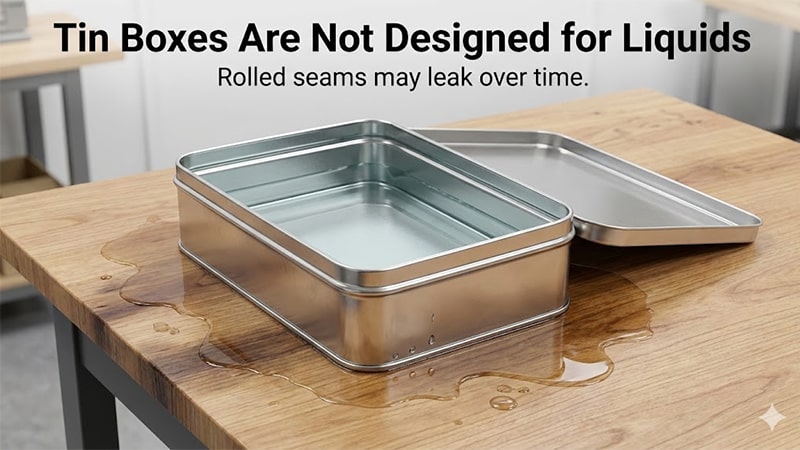
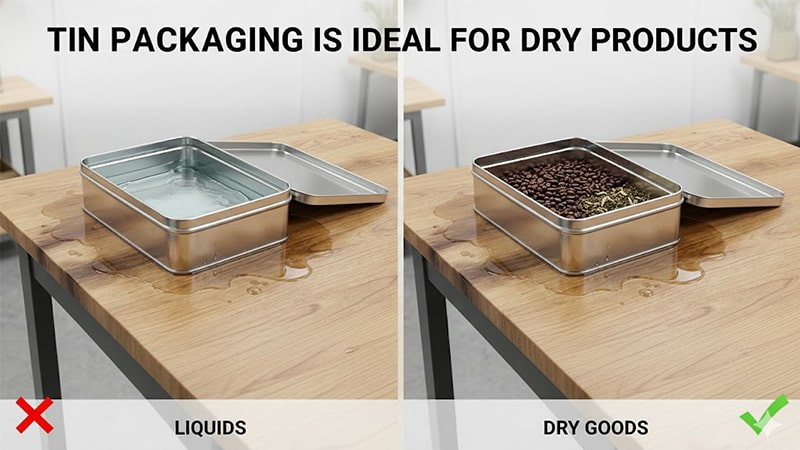
Tin boxes are not suitable for liquids due to their rolled-edge structure.
However, they can achieve excellent sealing performance for dry products when the right structure is selected.
This guide explains why tin boxes cannot hold liquids, how tin box sealing works, and how to choose the best solution for metal packaging for dry products.
In most cases, the answer is no.
As a custom tin box manufacturer, this is one of the most common questions we receive from beverage, food, and brand owners—especially those new to metal packaging.
Tin boxes are not designed for liquids such as:
Soda or carbonated drinks
Juice or functional beverages
Alcohol or liquid food products
The key reason lies in tin box sealing structure.
Most tin boxes are made using a rolled-edge (seamed) connection.
The metal edges of the body and lid or bottom are mechanically rolled together.
This structure is strong
It is cost-efficient
It works very well for solid products
But:
Rolled seams do not fuse the metal.
This leaves microscopic gaps—invisible to the eye, but potentially permeable to liquids over time.
There is another important risk to consider.
If liquid contacts the seam area:
It may slowly penetrate the joint
If the inner wall is not fully coated, corrosion or rust may occur
Long-term storage increases the risk of leakage and product contamination
From a responsibility standpoint, we do not recommend tin boxes for liquids, even with internal coatings.
Where tin packaging truly shines is metal packaging for dry products.
Typical applications include:
Tea and coffee
Biscuits and confectionery
Powdered food and supplements
Cosmetics and personal care
Premium gift packaging
For these products, airtight tin containers (for solids) can be achieved—when the right structure is chosen.
Different products require different sealing performance.
Below are the most common sealing solutions, explained with real usage scenarios.
Sealing level: ★☆☆☆☆
Best for:
Candy tins
Cookie tins
Gift tins
This structure protects against dust and handling damage, but offers limited moisture resistance.
Sealing level: ★★☆☆☆
Best for:
Tea leaves
Ground coffee
Powder-based dry goods
The inner lid reduces air exchange and improves basic sealing.
Sealing level: ★★★☆☆
Best for:
Premium tea tins
Reusable storage tins
This design improves usability and consistency, but it is not fully airtight.
Sealing level: ★★★★☆
Best for:
Coffee beans
Loose-leaf tea
Dry food ingredients
Typical customer scenario:
For a UK tea brand, TeaHouse, we designed a screw lid tin with an inner liner.
After switching from standard lids, their shelf-life stability improved significantly, and moisture-related issues were reduced by approximately 80%, according to customer feedback.
This structure is one of the most popular options for airtight tin containers for dry products.
Sealing level: ★★★★★ (for solids only)
Best for:
Food-grade dry products
Coffee and tea requiring freshness retention
Material recommendation:
Use food-grade PE or PP inner films
Select film thickness based on moisture sensitivity and shelf life
This solution provides the highest sealing performance available in tin packaging, but it is still not suitable for liquids.
Many customers ask for airtight tin containers.
In practice, airtight performance depends on:
Tin box structure
Lid type
Inner liner or film
Product storage conditions
A responsible custom tin box manufacturer should help you choose the right sealing system, not just promise “airtight” as a marketing term.
Tin boxes:
❌ Are not suitable for liquid packaging
✅ Are ideal for dry products requiring moisture protection
✅ Offer flexible sealing solutions when designed correctly
Choosing the right structure early can prevent costly mistakes later.
Send us your product details and storage requirements.
Our engineers will recommend the best tin box structure and provide:
Sealing solution advice
3D design support
Free samples for evaluation
Contact us to discuss your custom tin box sealing solution.
Obtenha as últimas informações e ofertas especiais


 Rede IPv6 suportada
 Português
 English
 Français
 Deutsch
 Español