
If you work with tea or coffee packaging long enough, you start to see the same issue again and again: the product itself may be excellent, but the wrong canister structure can still reduce freshness, create filling problems, or weaken shelf appeal.
This is especially true for tea and coffee. Both products are sensitive to air, moisture, light, and outside odors. Coffee adds one more practical packaging concern after roasting: gas release. That is why “airtight” is not just a simple feature. In real B2B projects, it is a structure decision.
For buyers sourcing wholesale tin canisters for tea or custom coffee tins with lid, the right choice usually comes down to five things: product type, lid structure, size fit, food-contact suitability, and how the pack will be used after opening.
In this guide, we focus on the practical side of selecting airtight tin canisters for tea and coffee—what buyers should really check before moving into sampling or production.
Tea and coffee may sit in similar containers, but they do not behave exactly the same way.
Tea is highly sensitive to light, moisture, and odor contamination. Loose leaf tea, in particular, can lose its aroma faster than many buyers expect if the canister does not close well or if the structure is not suitable for repeated opening and closing.
Coffee faces the same risks, but roasted coffee also changes over time after packing. Ground coffee is especially vulnerable once opened, while whole bean coffee may require a packaging plan that takes post-roast degassing into account.
So when a supplier says a tin is “airtight,” buyers should not stop at that word alone. The more useful question is: airtight for which product, under which filling condition, and for what kind of end use?
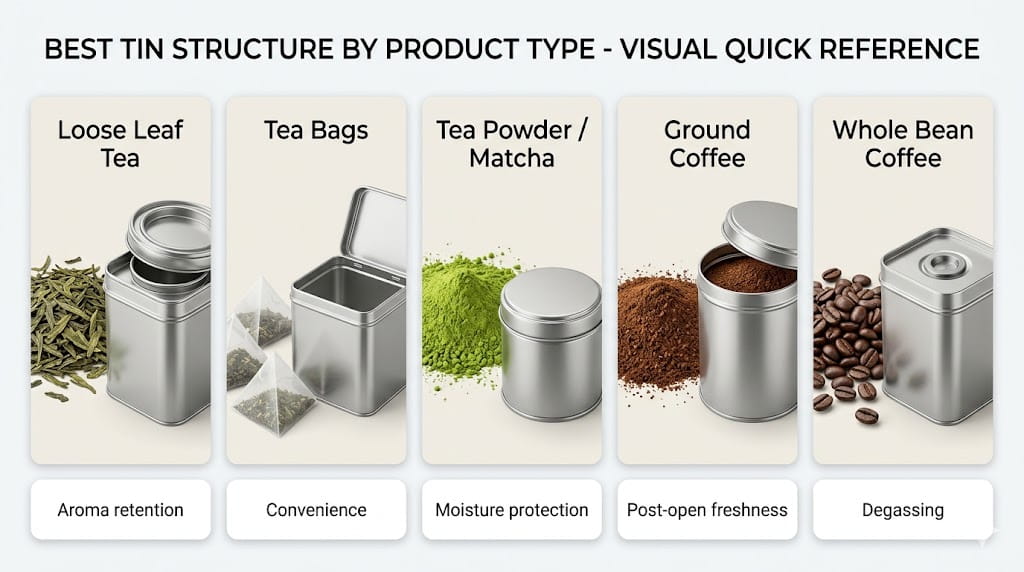
| Product Type | Best Tin Structure | Key Concern |
| Loose Leaf Tea | Double lid | Aroma retention |
| Tea Bags | Hinged lid / Slip lid | Convenience |
| Matcha or Tea Powder | Tight-fitting small canister | Moisture protection |
| Ground Coffee | Tight-fitting lid | Post-open freshness |
| Whole Bean Coffee | Tin + valve / inner bag | Degassing |
If the product type is already clear, this table usually helps eliminate the wrong canister options early.
One of the most common sourcing mistakes is treating tea and coffee as if they require the same packaging solution. They overlap, but not completely.
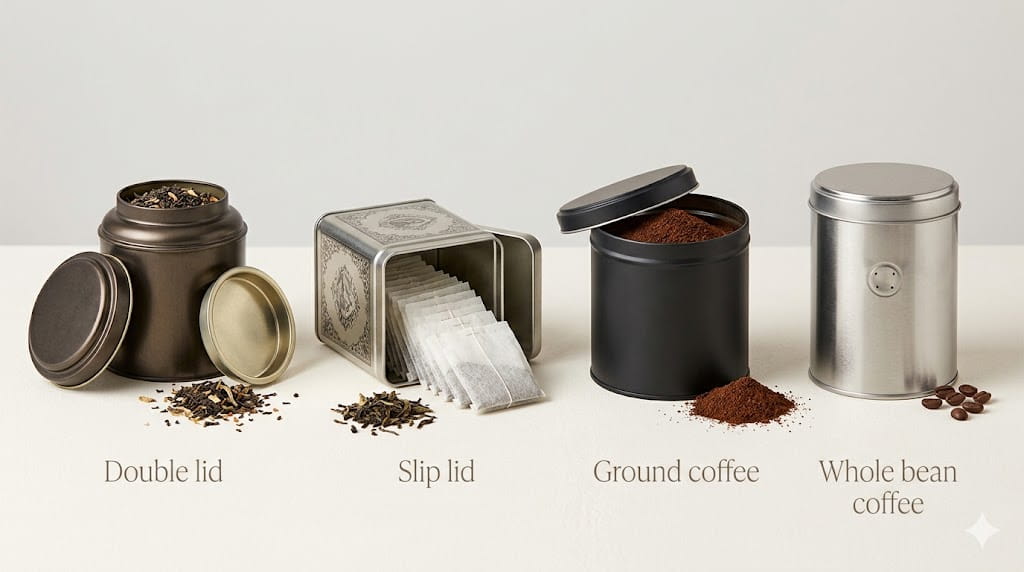
Loose leaf tea usually benefits from a double-lid structure. From a practical packaging point of view, the reason is straightforward: better aroma protection, better resistance to outside odor, and more reliable reclosing during daily use.
For premium tea products, especially those sold in specialty shops or gift channels, the double-lid structure is often worth the extra attention because it protects both product freshness and perceived value.
Tea bags are a different case. If the tea bags already have individual envelopes or inner sealed wrapping, the outer tin does not always need the same sealing performance as a loose leaf tea canister.
In those projects, a hinged lid or slip lid can be the more practical option. The packaging decision becomes less about maximum aroma retention and more about convenience, visual presentation, and cost control.
Ground coffee is more exposed by nature, so once the package is opened, freshness tends to drop faster. In this case, a good lid fit and a sensible pack size often matter more than decorative structure.
Many buyers focus on the look of the tin first, but with ground coffee, sealing performance after first opening is usually the more important question.
Whole bean coffee generally holds its character better than ground coffee, but it introduces another packaging consideration: degassing.
For fresh roast projects, the right solution may not be a tin alone. In some cases, the better structure is a tin used together with an inner bag or a one-way valve system, depending on how the coffee will be packed and how soon after roasting it goes into the canister.
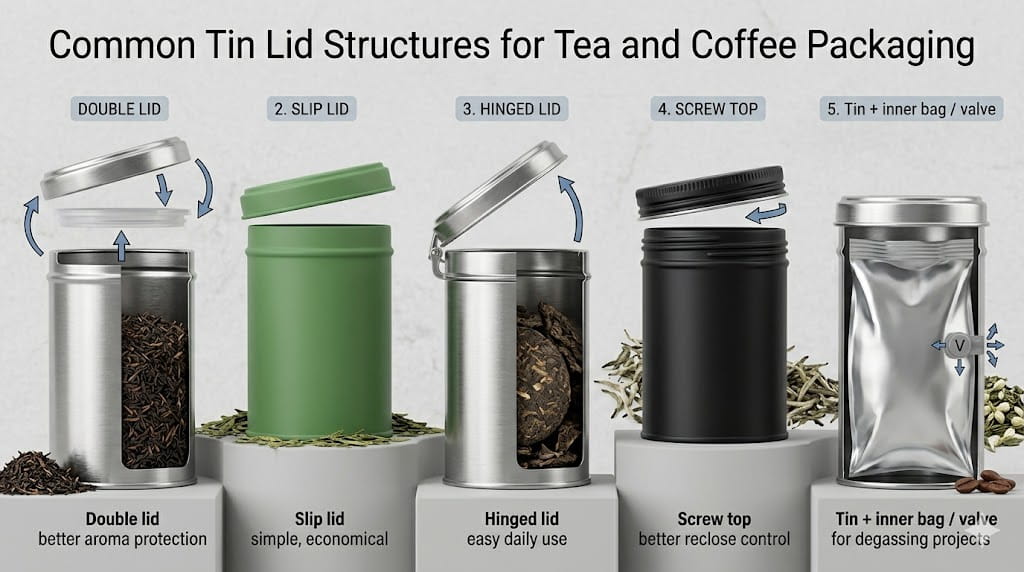
| Lid Type | Best For | Main Advantage | Watch Out For |
| Double Lid | Loose leaf tea | Better aroma protection | Slightly higher cost |
| Slip Lid | Standard tea packs | Simple and economical | Lower reclose consistency |
| Hinged Lid | Tea bags / samplers | Easy daily use | Not ideal for premium aroma retention |
| Screw Top | Powder products | Better reclose control | Not always the best visual fit |
| Tin + Valve / Inner Bag | Whole bean coffee | Better for degassing projects | Requires more structure planning |
For buyers, this is usually the most useful way to compare options: not by shape first, but by product behavior and lid performance.
This is one of the most common mistakes in tea and coffee tin sourcing.
A buyer may say, “We need a 100g tea tin,” or “We need a 250g coffee canister.” That sounds clear, but in practice, it is only a starting point.
Different products occupy space differently:
This is why experienced buyers usually confirm size by actual filling test, not by net weight alone.
In many projects, the issue is not the quality of the tin itself. The issue is the mismatch between product density and canister volume. When that happens, the result is often too much headspace, poor shelf presentation, inconsistent fill appearance, or weaker freshness performance after opening.
If buyers want to avoid unnecessary sampling delays, size fit should be checked with the real product as early as possible.
When buyers are deciding between two different lid structures, the most useful step is often not more discussion, but a simple side-by-side product test.
In practice, this means filling both structures with the actual tea or coffee product and checking them over time under normal use conditions. For loose leaf tea and ground coffee especially, the differences usually become clearer after repeated opening and closing.
The first points where performance starts to separate are usually:
This kind of packaging evaluation does not need to be complicated. But it should use the real product, not an empty decorative sample.
In many projects, buyers spend too much time discussing printing, embossing, or shape before confirming whether the material itself is suitable.
For tea and coffee packaging, buyers should also check:
This is especially important for international buyers sourcing from a tin canister supplier in China. Appearance matters, but if the material and structure are not suitable for the product, appearance alone will not solve the real packaging problem.
One common issue in tea and coffee packaging is choosing a canister mainly for appearance.
At the early stage, that choice can look fine. The tin looks premium, the shape is attractive, and the print concept works well. But after filling, shipping, or repeated end-user opening, the real problem appears: the structure does not match the product.
In practical terms, this usually shows up in one of four ways:
In other words, many packaging complaints are not caused by poor printing or poor design. They are caused by a mismatch between product behavior and canister structure.
That is exactly why B2B buyers should confirm the functional side of the canister before finalizing decoration details.
The best tin canister is not always the most complex one. It is the one that fits the product, supports the filling process, protects freshness, and works for the customer after opening.
In real sourcing, the most useful questions are often very simple:
Once those answers are clear, the packaging choice becomes much more accurate.
This is also why, in many cases, helping a buyer avoid one wrong structure is more valuable than showing ten attractive canister styles.
Choosing airtight tin canisters for tea and coffee is not only about making the packaging look premium. It is about making sure the structure fits the product, the use condition, and the buyer’s business objective.
For loose leaf tea, double lids are often a safer choice when aroma retention matters. For tea bags, convenience may be more important than maximum sealing. For ground coffee, post-open freshness should be checked carefully. For whole bean coffee, degassing may need to be part of the packaging plan from the beginning.
If you are sourcing wholesale tin canisters for tea or custom coffee tins with lid, it is usually better to start with product type, target fill size, and usage condition before reviewing decoration details.
The right tin canister does more than hold the product. It helps protect freshness, reduce packaging mistakes, and support the value of the brand on shelf.
If you are comparing canister options for tea or coffee, send us your product type, target fill weight, and preferred tin shape.
We can help you check:
Sometimes the best packaging decision is simply avoiding the wrong one before sampling starts.
Obtenha as últimas informações e ofertas especiais


 Rede IPv6 suportada
 Português
 English
 Français
 Deutsch
 Español