
A cookie tin quotation is not a single number. It is a summary of dozens of decisions made before the first sheet of tinplate is cut.
That's why two suppliers can quote noticeably different prices for what looks like the same project. One may be pricing a standard existing mould, exterior printing, and basic export cartons. The other may have included a fitted insert, a new embossing die, food-contact documentation, and delivery to port. On paper, the unit prices sit side by side. In reality, the packages aren't comparable at all.
We've seen a buyer receive two quotes — USD 1.20 and USD 1.65 per tin — and assume the cheaper supplier was the better deal. After normalising for the missing PET tray, inside printing, and FOB delivery, the "cheaper" quote came out higher. That's the problem this guide addresses.
This article explains how to read a custom cookie tin quotation, which questions to ask, and where small decisions can quietly shift the total project cost. It is not a universal price list. Material prices, exchange rates, and production specifications change. A dependable quotation must be tied to a defined pack.
The completed cost is usually built from three layers:
One-time development costs — new tin tooling, embossing dies, PET tray tooling, printed samples
Recurring production costs — tinplate, printing, forming, inserts, assembly, export packing
Delivery and commercial costs — freight, pallets, insurance, import duties, local handling, depending on the agreed trade term
The useful calculation is:
Total project cost = tin production + tooling and setup + inner packaging + sampling and testing + export packing + freight and import costs
The table below is a starting point for checking the scope of a quotation.
| Cost driver | Cost type | How it affects the quotation | What the buyer should confirm |
| Tin size and shape | Recurring; tooling may also apply | Changes tinplate use, forming steps, and carton volume | Finished dimensions and whether the mould already exists |
| New tin tooling | Usually one-time | Required for a new size, structure, or proprietary shape | Components included, ownership, and future reuse |
| Tinplate specification | Recurring | Affects rigidity, forming behaviour, and material cost | Thickness, coating, and the reason for the specification |
| Lid and closure | Recurring; tooling may apply | Changes component count, forming, and assembly | Slip, plug, hinged, window, or another structure |
| Printing and coatings | Recurring; setup may apply | Depends on coverage, colours, inside printing, and varnish | Exact print scope and approved colour standard |
| Embossing or debossing | Usually tooling plus recurring setup | Requires a matched die and stable forming position | Area, depth, location, and whether the die is included |
| Insert or inner packaging | Recurring; tooling may apply | Adds material, assembly, and sometimes a larger tin | PET tray, divider, paper cup, bag, pad, or flow wrap |
| Quantity and design count | Recurring | Fixed setup is spread across the production run | Quantity per size and per printed design |
| Packing labour | Recurring | Manual folding, loading, and sealing can reduce line speed | Who assembles the insert and fills each component |
| Sampling, testing, and documents | One-time or project-specific | Depends on sample type and destination-market requirements | What is included and which reports are required |
| Export packing and trade term | Recurring and shipment-specific | Changes protection, carton volume, and quoted delivery point | EXW, FOB or another term; cartons and pallets included |
The first cost decision is not the artwork. It is the pack-out.
A tin that holds 20 loose butter cookies may hold fewer once paper cups, a PET tray, or a folded barrier bag is added. If the original tin becomes too small, the project moves to a larger mould. That increases the tin itself and may also change the export carton, pallet pattern, and freight volume.
An insert can increase cost twice: first as an additional component, and again by requiring a larger tin.
The same principle applies to headspace. A sealed bag may fit when empty but become too tall after filling. A paper cup selected by its base diameter may open considerably wider around the cookie. A tray flange can use several millimetres around the perimeter. None of these details looks expensive on its own, but together they determine the real package size.
This is why capacity work should be completed before requesting a final quotation. Measure production-representative cookies, confirm the required count, and test the intended arrangement inside the actual inner packaging. A catalogue capacity number is a guide, not a guarantee.
Using an existing mould is normally the quickest route to a cost-effective custom tin. It avoids developing a new basic tin structure, shortens the engineering stage, and gives the factory a known production process.
It does not mean that every development cost disappears. The project may still require a structural sample, printed sample, machine setup, embossing die, or separate tooling for a formed insert. The existing tin must also pass the pack-out test.
We learned this with a client who insisted on using an existing 180 mm round mould to save tooling. With their PET tray and paper cup combination, only 14 cookies fit instead of the required 16. The "saving" disappeared when we had to open a 200 mm mould anyway — and the project lost two weeks in resampling. Now we always run the pack-out test before committing to an existing mould.
Jinyu maintains more than 3,000 existing moulds across different sizes, shapes, and lid structures. A mould search should therefore come before a decision to open new tooling. The useful information is the finished cookie size, count, and inner packaging — not simply a photograph of a tin that looks suitable.
New tooling becomes relevant when a brand needs an exclusive dimension, an unusual shape, or a structural feature that an existing mould cannot provide. Before approving it, confirm:
Which mould components are included
Whether separate dies are needed for the lid, body, bottom, or embossing
Who owns the tooling
Whether it can be used for future orders
What happens if the structure changes after sampling
Embossing and debossing deserve separate attention. A small logo positioned in the flat centre of a lid is generally more predictable than a large embossed area close to a rolled edge or curved corner. The final price depends on the design area, relief, registration requirement, and forming risk. So "embossing included" is not a complete specification.
Larger tins usually require more tinplate, but weight is only part of the calculation. Sheet layout, component shape, forming depth, and the number of production steps also matter. An irregular profile may require different tooling and leave more unused space in the export carton. A deep body may need tighter forming control than a shallow tin with a similar footprint.
Tinplate thickness should be selected around the structure and distribution route. At Jinyu, common options include 0.23 mm, 0.25 mm, and 0.28 mm. For many regular cookie tins, 0.23 mm is a practical starting point. Larger tins, heavier contents, or packs exposed to greater stacking pressure may need 0.25 mm or 0.28 mm.
Thickness alone does not determine strength. Panel size, corners, rolled edges, ribs, lid fit, and overall geometry all contribute. Specifying the thickest material for every project adds cost without necessarily improving performance. Specifying material that is too light can create denting, distortion, or inconsistent closure. The supplier should be able to explain why a particular thickness suits the proposed tin.
The lid also changes the quotation. A basic slip lid has a different component and assembly process from a plug lid, hinged lid, or window lid. Hinged structures introduce additional forming and assembly work. A window lid adds another material and sealing or assembly step. These features may be worthwhile for convenience and presentation, but they should solve a real packaging need.
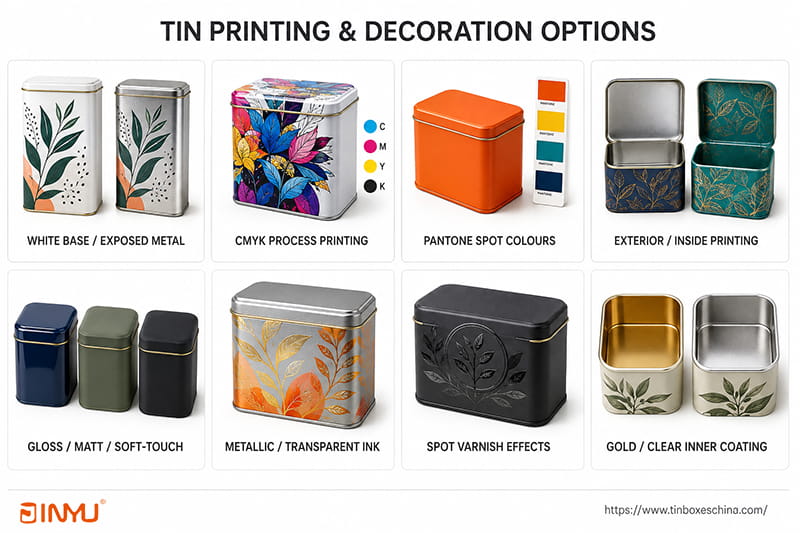
Tinplate is normally printed in flat sheets before the components are cut and formed. The quotation therefore depends on more than the number of colours visible on the finished box.
The print specification may include:
A white base coating or exposed metallic areas
CMYK process printing
One or more Pantone spot colours
Exterior-only or inside-and-outside printing
Gloss, matt, or soft-touch varnish
Metallic ink or transparent colour over metal
Spot varnish or other registered effects
A standard gold or clear food-contact inner coating
Pantone is not automatically expensive, and CMYK is not automatically economical. Cost depends on the number of ink preparations, plates, print passes, coating system, and minimum setup charges.
We recently quoted a project where the client's design used CMYK plus four Pantone colours. When we broke the quote down by process, they realised two of the Pantone colours appeared only on a thin border line. Switching those to CMYK equivalents saved roughly 8% on print setup without a visible difference on the finished tin.
Inside printing is another common source of quote differences. One supplier may include a standard gold or clear inner coating, while another has priced a fully printed interior. If the inside artwork does not improve the opening experience enough to justify the additional process, a standard inner finish is often the more practical option.
The number of designs also matters. An order of 10,000 tins with one design is not necessarily priced like two designs of 5,000 each. Different artworks can require separate sheet layouts, colour setup, production control, and packing identification. Request the quotation by size and by design rather than providing only the combined annual quantity.
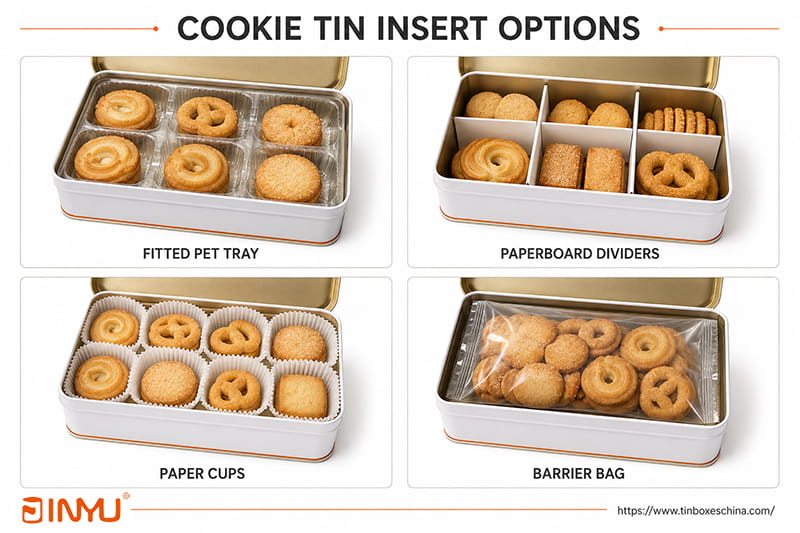
Cookie tin inserts perform different jobs, and each brings a different cost pattern. A fitted PET tray may require forming tooling. Paperboard dividers may arrive flat and need folding or slot assembly. Paper cups consume packing time and usable width. Barrier bags need filling, heat sealing, and enough space for gussets and folded seals.
For quotation purposes, buyers should check four things:
Is the component itself included?
Is separate tooling required?
Who assembles, loads, or seals it?
Has the tin size been calculated around the finished insert?
Component price alone can be misleading. A low-cost divider may take longer to assemble than a formed tray. Paper cups may create an attractive gift presentation but slow manual loading. A barrier bag may protect shelf life while doing little to stop the cookies moving.
We ran this exact calculation for a client last year. They had chosen a flat-pack divider to save component cost. When we timed the assembly in our sampling room, the divider took 12 seconds longer per tin than a pre-formed tray. Across their 30,000-piece order, that was 100 extra hours of packing labour — about three times the cost saving on components.
Small handling differences become significant at volume. An additional 10 seconds per tin across 50,000 packs equals almost 139 operator-hours. A timed packing trial is more useful than guessing from the component quotation.
Custom tin production process includes work that must be completed whether the order is relatively small or large: artwork layout, print preparation, mould installation, machine adjustment, first-piece inspection, production control, and export packing setup.
At lower quantities, those fixed activities are spread across fewer tins. The unit price rises. As volume increases, the fixed cost per tin generally falls, although the buyer also takes on more inventory, storage, and cash-flow exposure. The cheapest unit price is not automatically the best purchasing quantity.
Jinyu's standard MOQ for custom printed cookie tins is 5,000 pieces per size and design. For a serious project, it is useful to request tiered quotations — for example, the required launch quantity and one or two realistic reorder volumes. This shows where the meaningful price breaks are without committing to stock that may take too long to sell.
If several seasonal designs share one tin structure, provide the quantity for each design. Do not assume they can always be combined into one printing run. Compatible sheet layouts or production schedules may sometimes create efficiencies, but they should not be treated as guaranteed savings.
"Sample included" can mean several different things:
An existing production sample showing the structure
A blank sample in the proposed size
A digital artwork mock-up
A printed colour proof
A fully formed sample using the proposed artwork and finish
Each answers a different question. An existing sample can confirm general workmanship. A blank sample can test capacity. A printed sample is needed to assess colour, varnish, metallic effects, and embossing on the actual structure.
Confirm whether the sample charge, tooling, colour adjustment, and courier cost are included, and whether any charge is credited against the production order. At Jinyu, custom sampling generally takes 7–10 days once the relevant structure and artwork are ready.
Food-contact requirements should be agreed before the quote is finalised. The appropriate coating, BPA-NI option, declaration, or test scope depends on the product, whether food contacts the tin directly, and the destination market. For EU shipments, food-contact materials must comply with Regulation (EC) No 1935/2004 and applicable good manufacturing practice requirements. For the US market, FDA 21 CFR 175.300 is the relevant reference for resinous and polymeric coatings. A generic statement such as "food grade" is not a substitute for defining the required documentation.
Quality scope matters as well. The quotation should make clear how the approved sample will be used, which points are inspected, and how finished tins are protected from scratching or deformation. A lower price can become expensive if colour, lid fit, insert dimensions, or export packing are not controlled consistently.
Empty tins are relatively light, but they occupy space. Freight can therefore be influenced as much by carton volume as by product weight.
Export packing may include individual bags, tissue, layer pads, carton dividers, reinforced master cartons, and pallets. These choices protect the printed surface and structure, but they also change the carton count and shipment volume. Round, rectangular, and irregular tins create different packing patterns; the only dependable comparison uses the actual tin dimensions and proposed carton layout.
We've seen the same 180 mm round tin pack 30% fewer units per carton than a rectangular tin of similar capacity. That difference flows directly into freight cost. If you're comparing quotations, ask for the estimated carton count per pallet — not just the unit price.
Trade terms must also match. An EXW quotation covers a different scope from an FOB quotation, and neither should be compared with a delivered price as if they were the same number. Ask each supplier to state:
The quoted trade term
The named location or port
Whether export cartons and pallets are included
The number of tins per carton
Estimated carton dimensions and gross weight
Which local, freight, and import charges remain outside the price
This is the point where "tin price" becomes "landed packaging cost." Buyers who compare only the unit line at the top of the quotation can miss a substantial part of the project.
The following example is illustrative. It is not a customer quotation.
A biscuit brand requests 5,000 rectangular tins for 12 decorated cookies. The pack requires a fitted PET tray, exterior artwork, a standard inner coating, and export shipment to the UK. Two suppliers respond.
| Quotation item | Supplier A | Supplier B | Why it matters |
| Tin dimensions | External size only | External and usable internal size | The insert must fit the usable space |
| Tinplate | "Standard thickness" | 0.23 mm confirmed | The unit prices may not use the same material |
| Tin mould | Existing mould | Existing mould | Both avoid new structural tooling |
| PET tray | Excluded | Included | Supplier A is not quoting the completed pack |
| PET tooling | Not stated | Listed separately as one-time | Future reorder cost will differ |
| Printing | "Full colour" | Exterior CMYK, matt varnish, standard inner coating | The print scope is defined only in Supplier B's quote |
| Printed sample | Additional charge, amount not stated | Listed separately with lead time | Approval cost and schedule need normalising |
| Export packing | "Standard carton" | Individual protection and carton quantity specified | Surface protection and freight volume may differ |
| Trade term | EXW | FOB named port | The delivery scopes are not comparable |
| Unit price | Lower | Higher | The lower number excludes several required items |
Supplier B is not automatically the better choice. Supplier A may still be competitive after the missing items are added. The point is that no decision can be made until both suppliers quote the same structure, material, insert, packing, and delivery point.
This is why a good quotation is specific. Vagueness usually postpones cost rather than removing it.
Some extra cost is intentional and worthwhile. A premium finish, custom shape, or fitted tray may be central to the product. The avoidable cost usually comes from decisions made in the wrong order.
| Common decision error | Typical cost impact |
| Freezing the tin size before testing cookie and insert together | Possible new mould, resampling, and project delay |
| Opening a new mould before checking suitable existing structures | Unnecessary tooling investment |
| Adding several decorative processes without ranking their value | Higher per-unit cost without proportional benefit |
| Changing artwork after the printed sample has been prepared | New sample, colour setup, and production delay |
| Splitting one practical production run into too many small designs | Each design carries separate setup costs |
| Specifying inside printing where a standard inner coating would work | Additional print pass with limited consumer impact |
| Choosing a low material specification without validating dent and stack performance | Higher damage rates and possible rejection |
| Comparing quotations with different trade terms or packing scopes | Wrong purchasing decision based on incomplete data |
| Approving the presentation pack without testing the final shipping carton | Damage discovered after production |
The solution is not to remove every premium feature. It is to make each feature earn its place.
Start by matching the pack to an existing mould. Then build the quotation around the real cookie count and inner packaging. These two decisions prevent many expensive changes later.
Further options include:
Use the lightest tinplate specification that passes the structural requirement rather than selecting thickness by impression alone
Keep the standard inner lacquer unless inside printing adds meaningful value
Place embossing in a stable, flat area and limit it to the part customers will notice
Reduce unnecessary colour or finish changes between designs
Decide the PET tray, divider, cup, or bag before confirming the tin dimensions
Time the actual assembly process during sampling
Request realistic quantity tiers rather than chasing an impractical high-volume unit price
Ask every supplier to quote from the same written RFQ
Cost control works best when it removes waste, not function.
A factory should not issue a confident final price from a reference photograph alone. The initial estimate may be useful, but an accurate quotation needs a clearer brief.
Provide as many of the following details as possible:
Finished cookie diameter, length, width, and thickness
Production tolerance and whether decoration changes the dimensions
Required number of cookies per tin
Preferred arrangement and number of layers
Proposed tray, divider, paper cup, bag, pad, or individual wrap
Preferred tin shape, size, and lid type
Quantity per size and per artwork design
Exterior and interior printing requirements
Varnish, metallic effect, embossing, or debossing
Food-contact and destination-market requirements
Individual protection and export packing requirements
Destination country, port, and preferred trade term
Target sample and production dates
Complete information does not lock the buyer into one structure. It allows the factory to identify suitable existing moulds, explain the trade-offs, and issue a quotation that needs fewer revisions.
There is no dependable universal unit price. The factory needs the tin size, structure, tinplate specification, printing, quantity, insert, export packing, and trade term. A price shown without those conditions is an estimate, not a complete quotation.
Tinplate printing and tin forming require sheet layout, colour preparation, mould installation, machine adjustment, and production setup. These activities are difficult to distribute economically across a very small order. Jinyu's standard MOQ is 5,000 pieces per size and design.
It normally avoids the cost of developing a new basic tin structure. However, it is only economical if the size and closure suit the cookie count and inner packaging. Sampling, embossing dies, or insert tooling may still be charged separately.
It adds a die and production setup, but the effect depends on the embossed area, depth, position, and design complexity. A modest logo on a flat lid is generally easier to control than large-area embossing near a rim or curved surface.
Not automatically. Each design may require a separate print layout, colour setup, production run, and packing identification. Request the quantity and price for each design. Any opportunity to combine compatible work should be confirmed by the factory rather than assumed.
Only if the quotation states that they are included. Confirm the component specification, tooling, assembly, and whether the tin dimensions were calculated around the finished insert.
That depends on the trade term and agreed project scope. Ask the supplier to identify the delivery point, export packing, freight responsibility, required reports, and any testing charged separately.
The cheapest-looking unit price is not necessarily the lowest project cost. A dependable quotation shows the tin dimensions, thickness, closure, printing, insert, packing, one-time charges, and trade term clearly enough for another supplier to price the same pack.
Before requesting a final quotation, confirm the cookie dimensions, count, inner packaging, order quantity, artwork requirements, and destination market. Jinyu can review the pack structure, compare it with existing cookie and biscuit tin box moulds, and separate one-time development charges from recurring production costs.
Send us your cookie dimensions, target piece count, and rough quantity. We'll respond with a mould-matching summary and a quotation structure that separates one-time costs from recurring production costs — typically within 48 hours.
Custom printed production normally starts at 5,000 pieces per size and design. Sampling takes approximately 7–10 days, followed by 25–35 days for mass production after sample approval.
Obtenha as últimas informações e ofertas especiais


 Rede IPv6 suportada
 Português
 English
 Français
 Deutsch
 Español