
A tin supplier can operate from a handy starting point of a 30 g mint pack. It tells you how much product to sell, but leaves the size open. We still need to know what the mints look like, how they will be wrapped and how they will be filled.
A shallow tin might be able to comfortably hold the loose mints, but then be hard to close when you add a sealed pouch. A different size could be a good candidate for hand packed sample but would slow down the filling line.
Look through the whole pack for the target fill and choose a mint tin. Estimate sizes with dimensions and volume estimates. Check the fit with real mints.
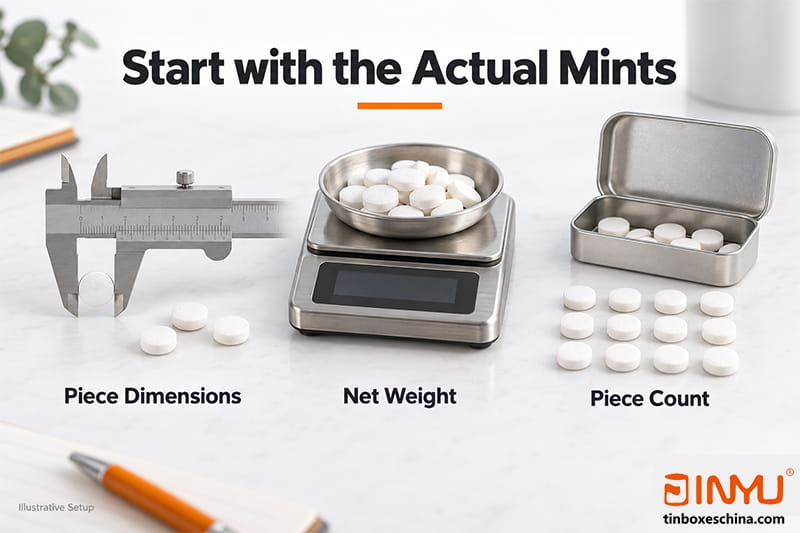
Before going through a mould catalogue, put a representative sample of the mints on the table. Measure length or diameter and thickness. Measure the wrapped product, including folded ends, if they are individually wrapped.
Note the intended net weight, piece count or both. If the pack is weight based, the counted sample provides an average piece weight and an estimated count. Measure again if the mints are noticeably different. Counted pack: Weigh the specified number of pieces and record the weight.
One number does not replace the other. Smaller mints could make more pieces at the same net weight, without requiring a larger tin. The size and placement of the windows affect the area of the windows.
| Initial point | necessary information | What it helps to establish |
| Net weight objective | Real mints, dimensions measured and method of filling | Amount of fill to be used |
| Target piece no. | Dimensions, weight change and wrapping the piece | the full count can fit and taken away |
| A tin size wanted | Internal drawing, opening and closing details | The room in that specific building |
| An inner bag sealed | Pouch dimensions including the fold filled and sealed | Lid insertion and pouch opening |
| A few mint flavours | Samples of all products and packaging | If the range can use a single tin size |
You may have to check a peppermint and a fruit mint from the same supplier separately. The coating, thickness and wrapping may differ from product to product. Keep the sample ID with the sizing notes.
Measure the volume occupied by a known weight of mints under a defined filling procedure for a rough estimate. Use a vessel large enough to allow the pieces to settle without jamming across the mouth. State whether the sampling was poured freely or settled by some controlled operation.
Bulk density is the net weight of the product divided by the volume it occupies It includes the spaces between the mints. For a weight-specified pack:
estimated fill volume (mL) ≈ target net weight (g) / measured bulk density (g/mL)
Hapman’s bulk-density measurement guide uses a known sample volume and weight and emphasises taking the sample from a relevant point in the process. Its density guide also explains why reference values are used for estimation in handling conditions rather than for final sizing.
This calculation helps to shortlist tins. A small pocket tin might contain the same mints in a different arrangement than the measuring vessel, especially in corners and at walls. Physical trial of the finished pack is still pending.
Imagine a format like our hinged mint tin, 60 x 50 x 15mm. The dimensions shown indicate the format; the drawing and sample determine its usable opening, internal dimensions and space with the lid closed.
Find where the closure enters or crosses the box. Test the rails and the entrance to a slide in tin. Look at the profile of the closed lid and the fitting edges on a tin with a hinge. The details are model-dependent.
Permit particle gaps, inner-pack space and lid clearance to vary. A bulk-volume measurement already includes the particle gaps. Similarly, if a supplier’s usable volume figure has already been corrected for closure space, don’t correct it again.
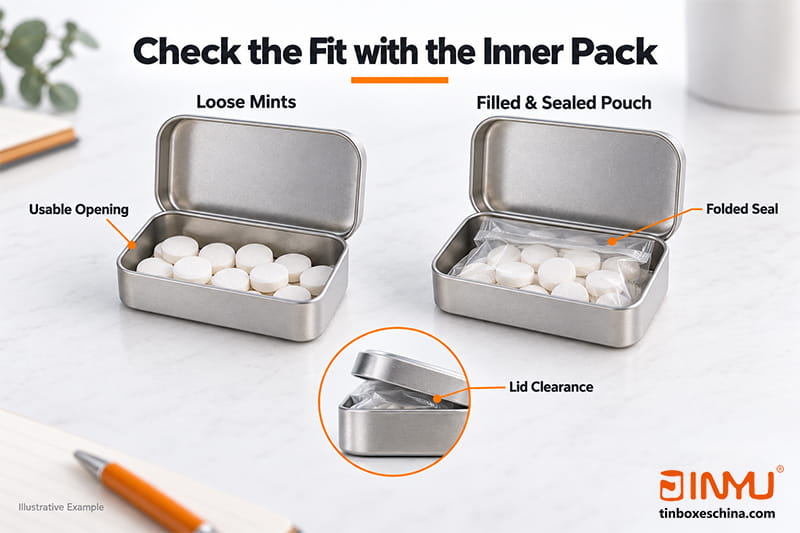
A pouch that has been filled and sealed will take up more space than its empty dimensions might suggest. In a shallow tin, the top folds in and the corners and seal margins can be the highest points. Paper liners need to lie as they will in production as well.
As a design example, let’s consider a brand developing a 30 g pressed-mint pack that includes a sealed inner pouch. Two shallow hinged tins are in the race. Loose mints are fine for either, but the decision is still made until the filled bags are sealed, folded and stuffed inside.
The checks now include the pouch passing through the opening, the folded seal reaching the lid fitting area, and the customer being able to lift the pouch out. You might want to try a different pouch fold or footprint, or extra depth might help.
Any change should maintain the seal and protective performance. Removing an inner pack to gain space changes the specification of the packaging. But before you do, check that decision with the confectioner.
Only include the liners, inserts or other components that are actually called for by the product. A stock list of possible accessories is not a sizing brief.
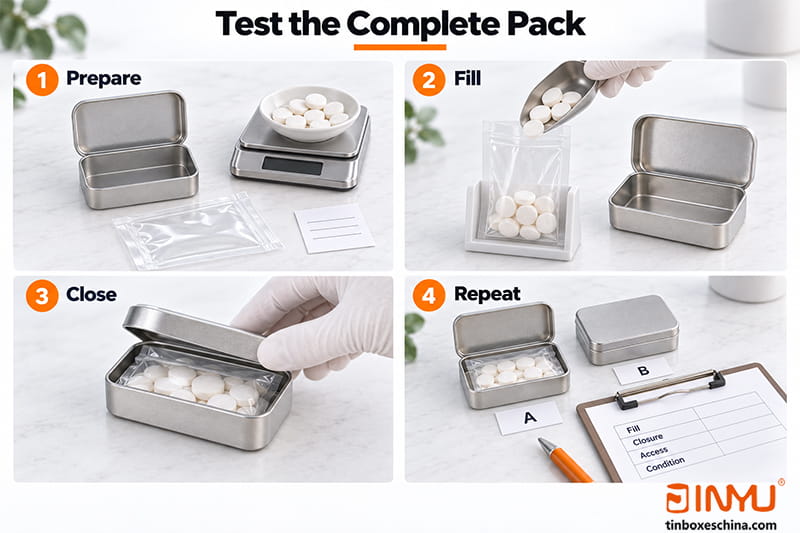
If two or three candidates seem appropriate, compare them using the actual mints and full packaging. Hold enough product for several refills and hold batch information.
If the filler uses vibration or settling, duplicate and record that operation. A sample that works when shaken does not prove a workable production process.
| Check Point | Add all candidates |
| Product and packaging | Tin reference, lid and inner-pack specifications Mint batch |
| Actual Quantity | Net weight Number of pieces (if applicable) Result of each test |
| How to fill | Weighing or Counting; Pouring; Arrangement and Settling |
| Fit when closing | Top fill point, pouch fold, trapped material and lid seating |
| Opening and Usage | Ease of access, dispensing and re-closure |
| Condition after handling | Goods movement, new damage and pack modifications |
Get agreement on acceptance criteria with the filling partner before approving the size. Check lid position, feed access, guides and closing equipment for machine filling. Successful bench sample needs to be confirmed on the intended process.
Open the pack as a customer would. Take out some mints. Close it and use again. Keep going until there are a few pieces left.
The pack must have an opening that can be handled for pouring. The user may have a sliding lid which exposes part of that opening but one still needs to check the movement of that and the actual mint dimensions. We cover the structural considerations in more detail in our sliding lid tin guide.
Check access for mints removed by hand near the bottom and corners. It remains inside the tin when in use, so when you’re finished, try to fold the pouch back into the tin.
"Expected some movement in a half-full tin. Watch for behaviour that causes problems, spills or damage. Filling to the rim in an effort to eliminate all movement can create a different problem at closure
Go back to the 30 g pouch example. If the lid touches the folded seal compare the position of the fold with the change of the closure profile change the whole tin. A revised pouch or a deeper candidate would require another full trial.
If the right fill seems too sparse, check a shallower or differently proportioned tin. First, ensure that it is a layout issue, not a filling error, that is producing the apparent empty space. An insert should have a clear purpose, such as positioning the pouch or assisting removal.
If hand-filling sample works, but production filling is bad, review opening and filling sequence with packer. More internal volume alone may not fix awkward access or lid handling.
A few sizes pass. Check appearance, pocket comfort, ease of filling, available tooling and carton arrangement. A new shape designed to remove a small amount of empty space may not be as well suited to the project as a slightly larger existing format.
Keep approved sample, drawing, fill records and photographs together. If the mint, wrapper, lid or filling process changes, check the fit again.
Determine the volume of a representative 30 g fill including its final inner packaging. Compare candidate tins with real sample. There’s no one-size-fits-all solution for every 30 g mint product.
The answer depends on piece dimensions, arrangement, wrapping and usable space. Count and weigh a real fill. If you see a gram capacity listed for another mint, it is just a starting reference.
Check the supplier’s convention. Ask for internal dimensions, the usable opening and the profile of the closed lid. External dimensions are helpful for retail and shipping plans, but do not describe every restriction inside the tin.
Allow normal fill variation, any pouch fold and no closure obstruction. Get the real LID & filling process. There is no fixed millimetre allowance for all mint tins.
Yes, if all products fit and work in the proposed pack. Different test flavours separately if dimensions, coating or wrapping are different. Matching art does not create matching capacity
Yes, if the end product uses one. Loose fill checks can assist early estimates, however size approval should be based on the filled, sealed and folded bag in the full tin.
Jinyu can help with comparison of existing mint & gum tin formats, review of dimensions, lid arrangement and inner-pack fit.
Send us your packaging brief along with mint photographs and dimensions, target net weight or piece count, inner-pack details, filling method and required quantity. A physical sample of the product is especially helpful when two sizes appear equally appropriate on paper.
Orders start at 5,000 pieces and are custom printed. Sampling is generally 7-10 days, and mass production is generally 25-35 days after sample approval, subject to final specification and production schedule.

Obtenha as últimas informações e ofertas especiais


 Rede IPv6 suportada
 Português
 English
 Français
 Deutsch
 Español