
For premium confectionery brands, packaging does far more than hold the product. It affects shelf presence, gifting value, product protection, and how consumers remember the brand after purchase. This is why chocolate tin packaging has become a preferred choice for many premium and gift-oriented chocolate lines.
Compared with folding cartons or flexible wraps, a chocolate tin box offers a stronger structure, a more premium tactile impression, and better opportunities for brand storytelling through printing, embossing, and reusable design. For brands developing artisan assortments, holiday gifts, seasonal launches, or export-ready collections, custom chocolate tins can combine visual appeal with practical performance.
This guide explains how to choose the right chocolate tin packaging, what food safety and structural details matter, how customization affects cost, and what buyers should prepare before starting a wholesale project.
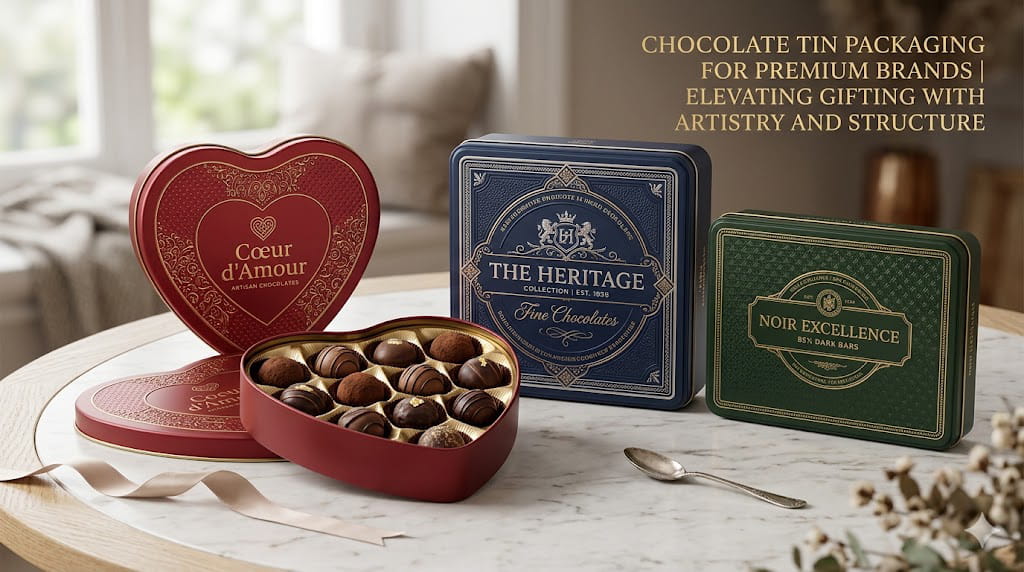
Chocolate is one of the most packaging-sensitive food categories. Consumers often associate the quality of the outer pack with the quality of the chocolate inside. In premium retail and gifting markets, that first visual and tactile impression can directly influence perceived value.
A well-made chocolate tin box offers several advantages:
For pralines, truffles, assorted gift chocolates, and limited-edition collections, the packaging is not just a container. It becomes part of the product experience.
Real project example
In one recent Valentine’s Day project, we developed a heart-shaped chocolate tin for a Belgian confectionery brand. By combining a fitted insert with a more transit-stable tin structure, the seasonal order volume reached 500,000 units while shipping damage was reduced to below 0.3%. This project showed how premium chocolate tin packaging can improve both shelf appeal and delivery performance.
Not every chocolate product needs metal packaging. For ultra-low-cost mass retail items, paper-based packaging may remain the more economical choice. However, a custom chocolate tin box is often a better fit when the project requires:
In practical terms, tins are especially suitable for premium assortments, festive packaging, corporate gifts, boutique chocolate launches, and high-value seasonal collections where appearance and protection both matter.
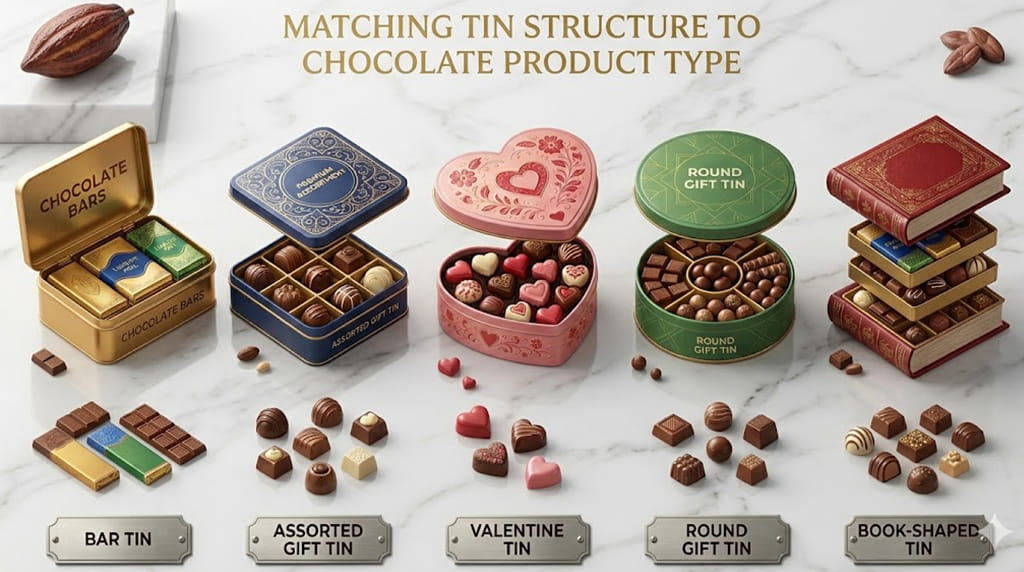
One of the most important decisions in chocolate tin packaging is matching the structure to the actual chocolate format. The right choice depends not only on shape, but also on internal depth, insert design, product count, and how the chocolates will be arranged inside.
| Chocolate Product Type | Recommended Tin Structure | Suggested Inner Solution | Best Use Scenario |
| Chocolate bars | Slim rectangular tin | Inner paper wrap or sealed pouch | Retail bars, gift bars, e-commerce |
| Truffles and pralines | Deep square or rectangular tin | Food-safe tray or divider insert | Premium assortments, fragile products |
| Assorted chocolate gifts | Book-shaped, square, or hinged lid tin | Compartment tray or layered insert | Seasonal gifting, holiday collections |
| Mini chocolate pieces | Round or small rectangular tin | Inner bag or portion compartments | Travel packs, promotions, retail gifts |
| Valentine or festive chocolates | Heart-shaped, star-shaped, or custom seasonal tin | Decorative insert or food-safe inner bag | Gift-focused campaigns |
| Hot chocolate gift sets | Tall tin canister or large specialty tin | Sachet arrangement or separated insert | Gift kits, winter promotions |
Choosing the correct structure early helps avoid wasted space, damaged surfaces, inefficient filling, and unnecessary shipping cost.
A strong chocolate gift tin packaging project often begins with selecting a shape that fits both the product and the brand message. Existing molds can already cover many popular commercial applications, which is why they are often the most efficient starting point for wholesale buyers.
These are among the most practical options for bars, assortments, and gift sets. They are efficient for packing, easy to stack, and suitable for large artwork panels.
Square tins work well for assorted chocolates and premium gift formats. They provide a balanced presentation and usually support neat internal layouts.
Round tins create a softer, more classic gifting impression. They are often used when brands want a more traditional or festive presentation style.
These are especially popular for Valentine’s Day, romantic gifting, and wedding-related chocolate packaging. They immediately communicate emotional value.
Book-style and other special structures are useful when brands want stronger storytelling, a collector feel, or a more memorable unboxing experience.
A premium appearance is important, but food safety is essential. For chocolate tin packaging, buyers should confirm how the packed product will interact with the internal structure and what level of food-contact protection is needed.
If the chocolate or its primary wrap may contact the inner metal surface, an appropriate food-grade inner coating is important. This helps support safe packaging use and protects the inside of the tin.
For many projects, especially those focused on freshness and aroma retention, a tin performs best when paired with an inner pouch, foil bag, or sealed wrap. In this setup, the tin provides structure and premium presentation, while the inner layer supports freshness control.
Premium chocolate assortments often need trays, partitions, or inserts to reduce movement during shipping and improve presentation after opening.
For export orders, buyers usually need to review the relevant documentation for destination markets. This is particularly important for projects going to North America and Europe.
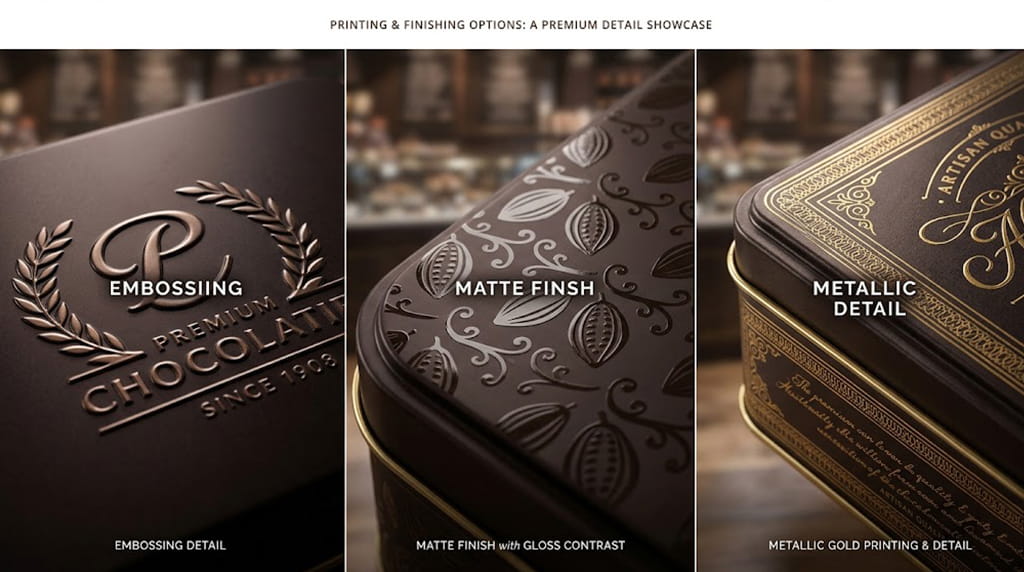
One major advantage of a custom chocolate tin box is its flexibility in decoration. The same base structure can look very different depending on the chosen printing and finishing methods.
Popular options include:
| Decoration Option | Visual Effect | Best For |
| Matte finish | Soft, elegant, modern | Luxury artisan brands, minimalist packaging |
| Gloss finish | Bright, high contrast | Retail impact, festive packaging |
| Embossing / Debossing | Tactile premium feel | Logos, signature brand details |
| Metallic effect | Rich and giftable appearance | Holiday, premium gifting, limited editions |
| Pantone color printing | Strong brand consistency | Established brands with defined color systems |
| Combination finish | Layered premium presentation | High-end collections and launch projects |
For most premium chocolate projects, the strongest result comes from combining two or three complementary finishes rather than over-decorating every surface.
This is one of the most practical decisions in custom chocolate tins development. A new mold can create exclusivity, but it also adds tooling cost and extends the development timeline. Existing molds are often faster, more efficient, and commercially sufficient for many projects.
| Option | Advantages | Limitations | Best For |
| Existing mold | Lower cost, faster sampling, shorter lead time | Less exclusive structure | Standard launches, budget-conscious projects |
| Custom mold | Unique shape, stronger brand distinction | Tooling fee, longer development cycle | Signature products, seasonal icons, long-term SKUs |
Practical sourcing example
In another seasonal packaging project, the customer initially planned a fully bespoke structure. After reviewing launch timing and budget, they selected an existing tin mold with custom artwork and embossed branding instead. This reduced development complexity while still creating a packaging format that felt distinctive on shelf.
For many buyers, using an existing mold and customizing the artwork, finish, and insert design offers the best balance between speed, cost, and brand differentiation.
Many buyers ask for pricing before all specifications are finalized, but the cost of chocolate tin packaging depends on multiple linked variables.
The main cost drivers usually include:
| Cost Factor | Lower-Cost Direction | Higher-Cost Direction |
| Structure | Standard square or rectangular tin | Specialty or irregular shape |
| Mold choice | Existing mold | New custom mold |
| Printing | Standard artwork | Multiple special effects and premium finishes |
| Interior | No insert or simple inner bag | Custom tray, divider, or layered insert |
| Quantity | Large repeat order | Small trial order |
| Packing | Standard export packing | Enhanced anti-scratch or gift-grade packing |
For this reason, buyers should evaluate packaging cost together with selling price, product positioning, and campaign purpose rather than as an isolated line item.
For global confectionery brands, the project is not finished when the tin design is approved. Lead time, export packing, and transit protection are equally important, especially for Christmas, Valentine’s Day, and other seasonal launches.
A typical project workflow includes:
When planning chocolate tin box wholesale orders, buyers should also consider:
Export handling example
For one premium assorted chocolate order, we optimized the outer carton layout and added protective separation between finished tins. This helped improve arrival condition after long-distance shipment and reduced the risk of scratches affecting retail presentation.
For seasonal launches, it is always safer to start the project earlier rather than later, especially when custom printing, inserts, or special structures are involved.
Sustainability remains important, but in premium chocolate categories, the strongest point of a tin is often reusability. A beautifully made tin is less likely to be discarded immediately. It may be reused for tea, biscuits, keepsakes, stationery, or small household storage.
That gives premium brands two benefits:
In gift-oriented packaging, that second life can be one of the most valuable branding benefits a package provides.
To receive useful recommendations, buyers should prepare more than only a target size. A clear brief makes it easier to recommend the right chocolate tin box, quote accurately, and shorten the development process.
It helps to prepare:
The clearer the project brief, the easier it is to identify an efficient and commercially suitable packaging solution.
They can be, depending on the internal packaging setup and project design. Many projects also use inner pouches, trays, or wraps inside the tin.
In many cases, yes. This depends on whether the product may contact the inside metal surface and how the chocolates are packed.
For premium gifting, stronger protection, and reusable branding value, a tin often offers clear advantages. For very low-cost mass retail, paper may still be the more economical option.
Yes. In most cases, an existing mold helps reduce tooling cost and shortens development time.
Yes. Inserts, trays, dividers, and inner pouches are commonly used to improve both presentation and protection.
Yes. They are widely used for Christmas, Valentine’s Day, corporate gifts, and limited-edition promotional collections.
The best chocolate tin packaging is not simply the most decorative option. It is the one that fits the chocolate product, supports the intended brand position, protects the contents properly, and makes commercial sense for the market.
For premium confectionery brands, a well-developed custom chocolate tin can do more than hold the product. It can improve shelf impact, increase gifting value, support export durability, and keep the brand visible long after the chocolates are gone.
If you are planning a new project, it is worth evaluating the tin structure, inner solution, decoration method, mold strategy, and transit requirements as one complete packaging system rather than as separate decisions.
Need help choosing the right chocolate tin box for your product line?
Share your chocolate type, target size, artwork direction, and expected quantity. We can help recommend a suitable structure, insert option, decoration method, and wholesale packaging approach for your project.
Obtenha as últimas informações e ofertas especiais


 Rede IPv6 suportada
 Português
 English
 Français
 Deutsch
 Español